


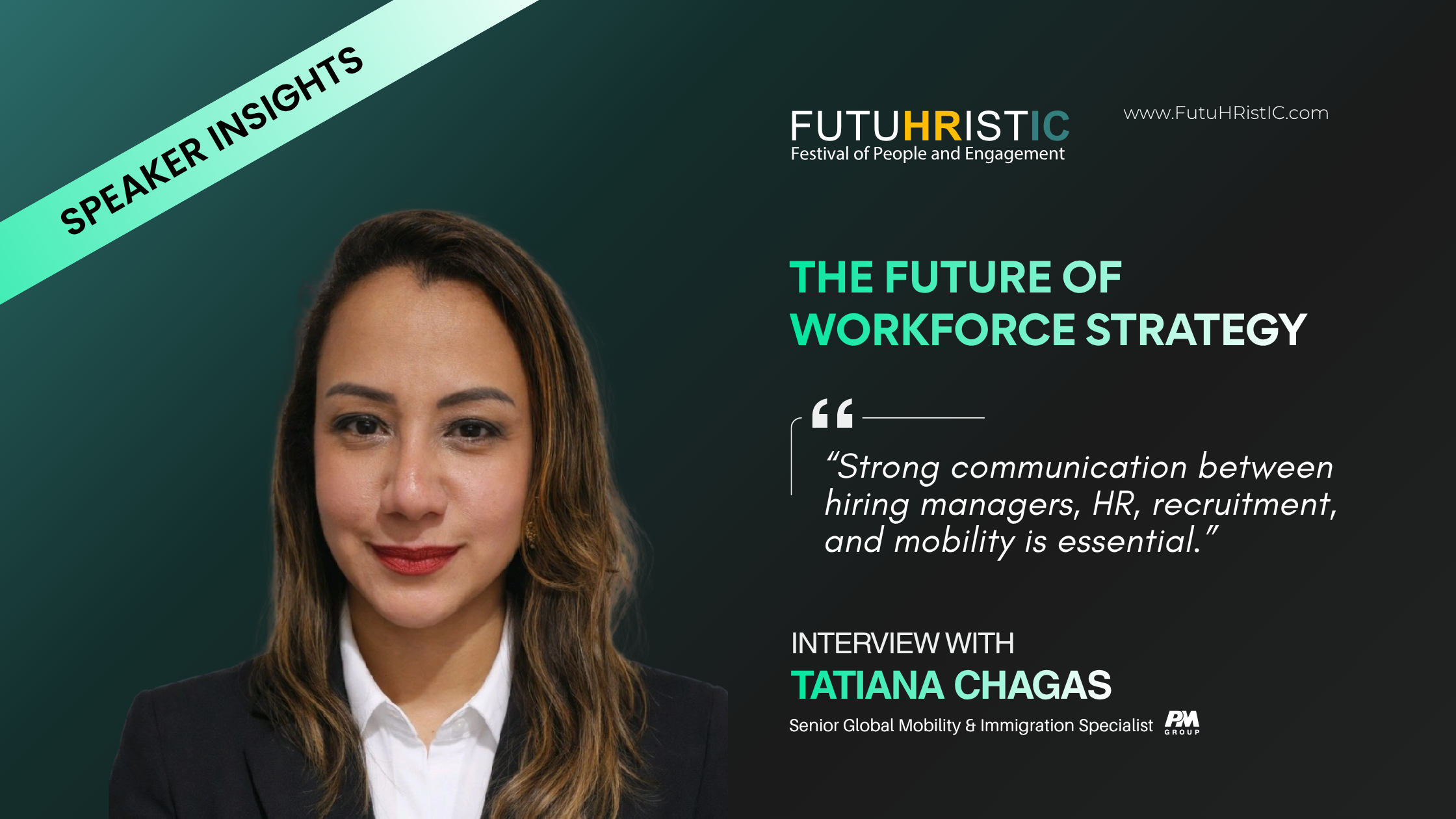
Speaker Insights: Tatiana Chagas, Senior Global Mobility Specialist, PM Group
In today’s increasingly interconnected business landscape, organisations are rethinking how they attract, move, and support talent across borders. As global hiring, workforce mobility, and compliance challenges continue evolving, businesses are placing greater focus on building internationally agile teams while balancing governance, employee experience, and operational efficiency.
At FutuHRistIC Festival 2026, The Festival of People & Engagement, HR, talent acquisition, leadership, and transformation professionals will come together in London for four days of conversations shaping the future of work. Through keynote sessions, interactive workshops, and collaborative networking, the festival explores the strategies, technologies, and human experiences driving workplace transformation today.
In this edition of our Speaker Insights interview series, we speak with Tatiana Chagas, Senior Global Mobility & Immigration Specialist at PM Group. Tatiana leads international mobility and immigration strategy across EMEA, APAC, and the Americas. With over six years of expertise spanning HR, recruitment, and global compliance, she specialises in enabling organisations to seamlessly access international talent pools.
At PM Group, Tatiana was instrumental in building the company’s mobility framework from the ground up, developing robust processes, policies, and compliance structures to support growth in highly regulated environments across the engineering, pharmaceutical, and technology sectors. Prior to this, she managed international talent mobility initiatives for global technology leaders including Microsoft and TIBCO.
We’re delighted to have you join us at the FutuHRistIC Festival 2026 this year. Your session will explore the realities of international employment. What key areas and challenges will you be focusing on during the session?
I will be exploring how global mobility has evolved from a purely operational function into a strategic enabler of international growth and talent acquisition. The session will focus on the realities of hiring across borders, the increasing demand for global talent, and the challenges organisations face when navigating immigration, compliance, and workforce mobility across different jurisdictions.
I will also discuss the role of mobility professionals in supporting business expansion, improving employee experience, and reducing compliance risks, while sharing practical examples from real mobility scenarios involving business travel, urgent mobilisation, and international hiring. In addition, I will explore how technology, automation, and smarter compliance processes are shaping the future of global hiring and workforce strategy.
What first drew you towards the world of global mobility and international workforce strategy?
My first experience with mobility started in Brazil, where I worked for a relocation company supporting expatriates who were moving there to live and work. I assisted them with housing, school searches, and settling into a completely new environment. One of the biggest challenges for many expatriates was the language barrier and adapting to a different culture, which made me realise how important the human side of mobility truly is.
When I moved to Ireland, I had the opportunity to work at Microsoft in a Talent Mobility role connected to international recruitment. It was one of the most challenging and rewarding experiences of my career. I supported large-scale assessment centre operations involving around 200 candidates from different countries, many of whom required visas to travel to Ireland for interviews and potentially work permits afterwards.
The level of coordination, planning, and international collaboration involved showed me how global mobility sits at the centre of talent, operations, and business strategy.
That experience made me realise that mobility is much more than immigration processes; it is about enabling opportunities, connecting talent globally, and helping organisations grow internationally.
What are some of the biggest challenges organisations face when creating global mobility structures in complex and highly regulated environments?
One of the biggest challenges organisations face is the lack of awareness around how complex international mobility and compliance can become when operating across multiple jurisdictions. Many companies expand globally very quickly, but their internal mobility structures, ownership, and processes do not always evolve at the same pace.
In highly regulated environments, organisations need clear governance, strong communication between teams, and a strong understanding of immigration, tax, social security, and employment regulations in each country. Without that structure, companies often face inconsistent processes, delays, compliance risks, and confusion around responsibilities.
Another challenge is that mobility touches many different areas of the business, HR, recruitment, payroll, legal, finance, travel, and project teams, so collaboration becomes essential. In my experience, building a successful mobility framework is not only about compliance; it is about creating processes that allow businesses to move talent efficiently while maintaining visibility, accountability, and employee support.
What are organisations still underestimating about the strategic value of global mobility?
Many organisations still view mobility primarily through the lens of visas, compliance, and administrative processes, rather than recognising its broader strategic value. In reality, a strong mobility programme can become a key enabler of international growth, workforce planning, and access to specialised talent.
When companies do not have the right mobility expertise or structure in place, global hiring can feel complex, slow, and risky. However, once organisations implement clear processes and create awareness around international mobility, they begin to see it differently, not as a barrier, but as a business enabler.
Global mobility supports project delivery, international collaboration, talent retention, and workforce flexibility. It also helps organisations respond more quickly to market demands and deploy specialised talent where it is needed most. In today’s global environment, mobility is becoming increasingly connected to business strategy rather than operating solely as a support function.
How do you see global mobility evolving as part of wider workforce planning and talent acquisition strategies?
I believe global mobility will become increasingly integrated into workforce planning and talent acquisition strategies rather than operating separately from them. As organisations continue competing for specialised talent globally, mobility professionals will play a more strategic role in helping businesses make informed hiring and deployment decisions.
One area that is often underestimated is how immigration and travel restrictions can directly impact workforce planning. For example, employees requiring visa sponsorship may face limitations when travelling internationally for projects or client work, particularly in regions with stricter immigration requirements. Understanding these limitations early in the hiring process can help organisations avoid future operational challenges and improve workforce planning.
Mobility professionals can provide valuable insight to recruitment and leadership teams by identifying potential risks, supporting international workforce planning, and helping organisations build realistic and sustainable global hiring strategies. I also believe technology and travel compliance automation will continue transforming the way companies manage international talent and cross-border work.
What are some of the most important lessons leaders should understand when managing international talent across borders?
One of the most important lessons is that managing international talent requires much more than simply relocating employees or obtaining visas. Leaders need to understand the wider impact of immigration, compliance, cultural differences, communication, and workforce planning on international operations.
Strong communication between hiring managers, HR, recruitment, mobility, and operational teams is essential. Many challenges arise when teams operate independently without understanding how international hiring decisions may affect project delivery, compliance obligations, or employee mobility restrictions.
Another important lesson is the value of multicultural teams and diverse perspectives. International talent brings innovation, adaptability, and global experience, but organisations must also create structures that support integration and long-term success.
In today’s environment, global mobility is not only about moving employees between countries, but it is about creating a connected and globally agile workforce.
How can organisations balance the need for agility and global growth while still maintaining strong governance and compliance standards?
Organisations can achieve this balance by building proactive rather than reactive mobility and compliance strategies. In a constantly changing global environment, companies need to stay informed about immigration and regulatory developments through government updates, industry webinars, conferences, and external expertise.
Having clear internal policies, defined ownership, and strong communication between teams is also critical. Compliance becomes much more manageable when organisations establish structured processes for international hiring, business travel, and workforce mobility before issues arise.
Technology is also playing an increasingly important role in helping companies improve visibility, automate processes, and manage travel and compliance risks more efficiently. Ultimately, organisations that succeed are usually those that integrate mobility, compliance, and workforce planning into their wider business strategy instead of treating them as isolated functions.
Are there common workforce or mobility trends you believe will shape the future of international employment over the next few years?
I believe several trends will continue shaping the future of international employment over the coming years. One of the biggest is the growing competition for specialised global talent, which is pushing organisations to rethink traditional hiring boundaries and become more open to international recruitment and cross-border workforce models.
At the same time, governments are increasing their focus on immigration compliance, business travel, tax exposure, and workforce transparency, meaning companies will need stronger governance and better visibility over where employees are working and travelling.
Technology and automation will also significantly transform the mobility function. Companies are increasingly looking for smarter ways to manage travel compliance, immigration processes, approvals, and workforce data in real time. This shift will allow mobility teams to move away from purely administrative work and become more strategic business partners.
I also believe employee experience will continue to become a major priority. International employees today expect smoother mobility processes, better communication, and greater flexibility when relocating or working globally. Organisations that can effectively combine compliance, technology, and employee experience will have a significant advantage in attracting and retaining global talent.
One of the strengths of FutuHRistIC Festival 2026 is bringing together diverse leaders from different industries. What value comes from having these cross-functional conversations in the same room?
Global workforce mobility impacts many different areas of an organisation, including HR, recruitment, operations, legal, payroll, finance, project teams, and leadership. Because of this, cross-functional discussions are extremely valuable in helping organisations understand challenges from different perspectives and collaboratively build more effective solutions.
These conversations also help create greater awareness around the operational and compliance implications of international hiring and workforce movement. Often, one team may not fully understand how their decisions can affect another area of the business, so bringing different functions together encourages better communication, alignment, and strategic thinking.
I also believe there is great value in connecting with professionals from different industries, backgrounds, and cultures. Sharing experiences and challenges openly often leads to more innovative ideas and stronger approaches to managing global talent.”
For someone attending your session at the festival, what would you most like them to walk away reflecting on afterwards?
I would like attendees to leave with a different perspective on global mobility, not simply as a compliance or administrative function, but as a strategic enabler of international growth, workforce flexibility, and talent access.
Many organisations still associate mobility mainly with complexity, visas, and risk. However, when companies build strong mobility structures, create awareness, and integrate mobility into wider business strategy, it becomes a powerful tool for enabling international collaboration and supporting business growth.
I also hope attendees leave with a better understanding that hiring beyond borders is not only about moving people internationally, but it is also about creating agile, globally connected organisations that can adapt to the future of work while maintaining compliance, employee experience, and operational efficiency.
About FutuHRistIC™ Festival
Since 2012, FutuHRistIC™ has been connecting people, culture, and communication. Now in its 12th year, this four-day London festival breaks down the silos between disciplines, bringing together the Reinventing HR Summit and the Internal Communications Conference. It is a collaborative space for forward-thinking people leaders and communication professionals to step away from day-to-day pressures, challenge ideas, and shape a more connected, human future of work.
With registrations now open, we invite professionals from across industries to join the conversations shaping the future of leadership, communication, culture, employee engagement, and organisational transformation.
Discover more about the festival, speakers, and programme updates at FutuHRistIC Festival.


