


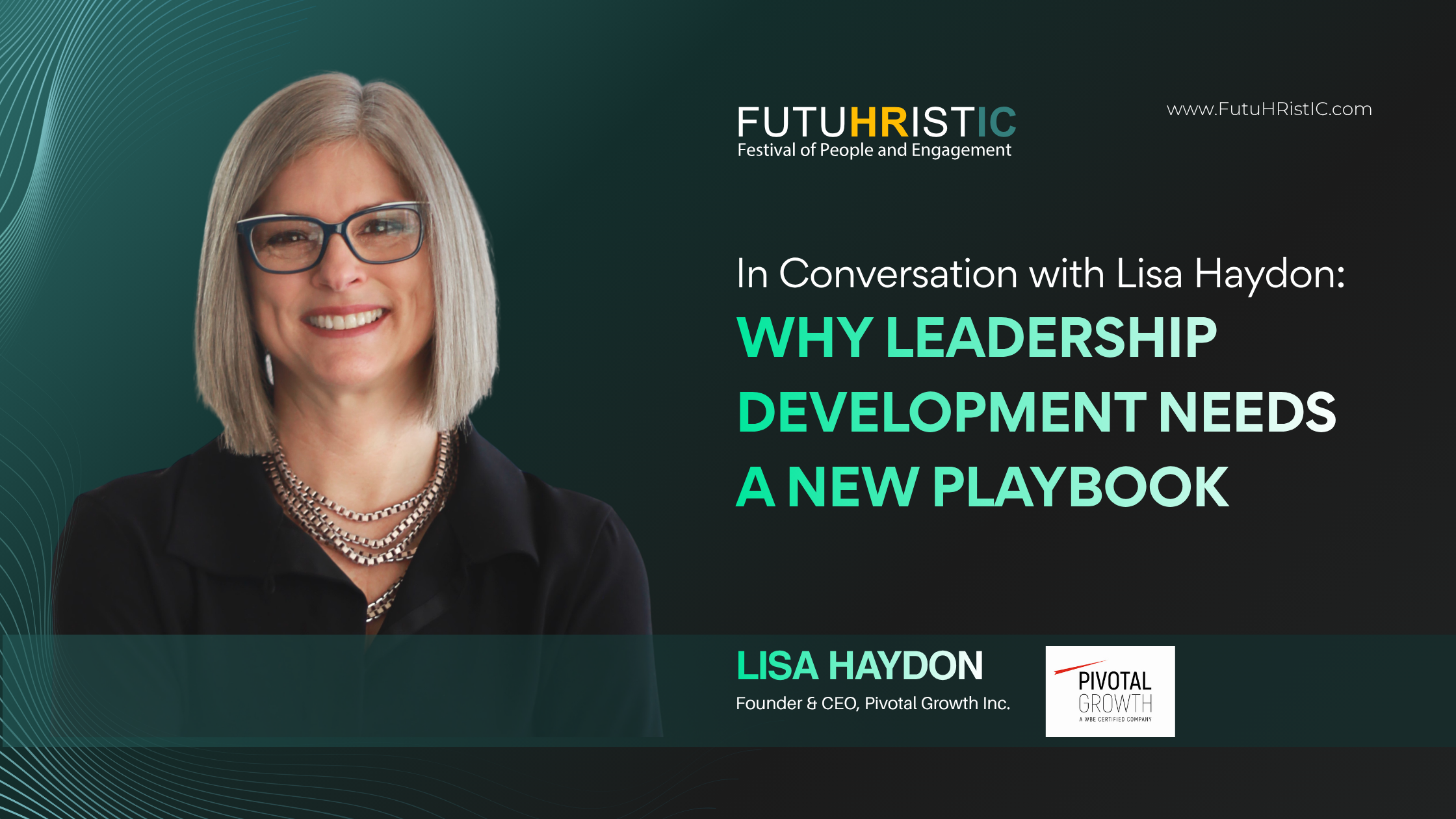
In Conversation with Lisa Haydon: Why Leadership Development Needs a New Playbook
What happens when an experienced leader knows how to lead well, but struggles to put that knowledge into practice under pressure?
For Lisa Haydon, Founder and CEO of Pivotal Growth Inc., this question sits at the heart of leadership development. Ahead of her appearance at FutuHRistIC Festival 2026, she shares why organisations need to look beyond skills and experience and understand what enables leaders to use them effectively.
Pivotal Growth Inc. is a modern leadership performance firm helping organisations make leadership a measurable driver of strategy, culture and organisational performance. Its integrated, human-centric and technology-enabled approach connects leadership strategy, behavioural measurement, AI-enabled diagnostics, executive coaching and organisational development to help organisations strengthen leadership capacity and make better talent decisions.
Lisa, what has shaped your approach to leadership development?
For the past eight years, I’ve worked alongside organisations and leaders to modernise how leadership is developed at scale.
Through that work, we’ve learned that development needs to begin with understanding the leadership capacity an organisation already has, what is constraining it and where investment will make the greatest difference.
Leaders often have considerable skills and experience. The challenge is helping them draw on those strengths when it matters most.
You say the leadership playbook has changed. What has changed about it?
Many leaders built successful careers around driving results, hitting targets and moving quickly. They learnt to think clearly, decide decisively and execute, with efficiency and accountability at the centre of their approach.
Results still matter. What has changed is how leaders achieve them.
The way a leader builds and preserves trust, adapts to different people and stays engaged under pressure affects their team’s ability to perform. Relational intelligence and leadership presence are essential to delivering results through people.
What is the difference between leadership capability and capacity?
Capability is the skills and experience a leader has. Capacity is their ability to access and use those strengths effectively in the situation they face.
Consider a director with a strong track record and technical expertise. When her team faces a crisis, she starts holding information more closely, making decisions faster and closing down conversations. To her, it feels like taking charge. Her team experiences anxiety.
She has the capability, but pressure is limiting her ability to lead in a way that enables others to perform. Development needs to help leaders recognise that connection and keep their strengths available when demands increase.
Why does understanding good leadership sometimes fail to change behaviour?
Understanding something intellectually does not necessarily mean you can put it into practice.
In one health system, hundreds of managers completed a customised leadership diagnostic. The results revealed patterns of low self-confidence, a strong inner critic and high relational intelligence. Managers understood their reports, but needed help connecting those findings to their everyday leadership.
Working with certified Impact Coaches helped them make that connection. One manager recognised that her internal self-criticism influenced her interactions with her team, making people cautious. Another saw that the speed which had helped build her career was becoming a barrier in a role that required her to mobilise others.
The important step was seeing how their internal patterns affected the way other people experienced their leadership.
What should organisations look at when assessing leadership capacity?
Three dimensions deserve attention.
Internal grounding is a leader’s stability under pressure.
Relational presence concerns how other people experience their leadership.
Stretch bandwidth is their ability to sustain effective execution and performance.
Organisations often develop and promote people based on skills and experience. Looking at these dimensions helps reveal whether leaders can use those strengths effectively when the situation becomes more demanding.
What does this mean for senior leaders who lead other leaders?
Senior leaders are expected to provide clarity while learning in real time themselves.
AI, changing workforce expectations and new ways of organising work mean they increasingly need to lead before they have complete answers. A leader who remains open, curious and connected creates different conditions from one who responds to uncertainty by tightening control.
Experience helps us put change into context. Learning agility helps us adapt to it.
Senior leaders need to understand their own leadership profile and recognise when familiar thinking and behaviours are no longer serving the situation.
How should HR teams rethink leadership development?
Development needs to be informed by data, personalised and supported by coaching. We need to understand what is happening for leaders and how that affects the way they lead.
That introduces complexity for HR functions which also need consistency, efficiency and scale. It also creates an opportunity to connect development more closely with organisational performance.
I would begin with three questions:
• What outcomes and results does leadership need to achieve?
• What does the current leadership performance profile tell us?
• Where will development investment create the greatest impact?
The answers help establish direction, identify priorities and provide a basis for measuring progress.
Where would you encourage leaders and organisations to start?
I would suggest two parallel tracks: your own leadership development and the leadership systems within your organisation.
For an individual leader, that means understanding your profile, recognising how you respond under pressure and protecting your capacity to stay present, focused and effective.
For the organisation, it means building systems that help leaders turn their capabilities into performance, with clear direction, useful data, support and reassessment.
Leadership change requires opportunities to understand yourself, apply that understanding and examine its impact on others.
About Lisa Haydon
Lisa Haydon is Founder and CEO of Pivotal Growth Inc. She brings more than 30 years of executive leadership experience and has spent the past eight years working with organisations to modernise leadership development. Her work explores how leaders can respond to changing workplace expectations and translate their capabilities into performance.
Pivotal Growth Inc. is a sponsor of FutuHRistIC Festival 2026.
Learn more about Pivotal Growth
Meet Lisa at FutuHRistIC Festival 2026
Join us on 17–20 November 2026 at The Bentley Hotel, London, for discussions, practical learning and professional connections across HR, Internal Communications, workplace culture and leadership.


