


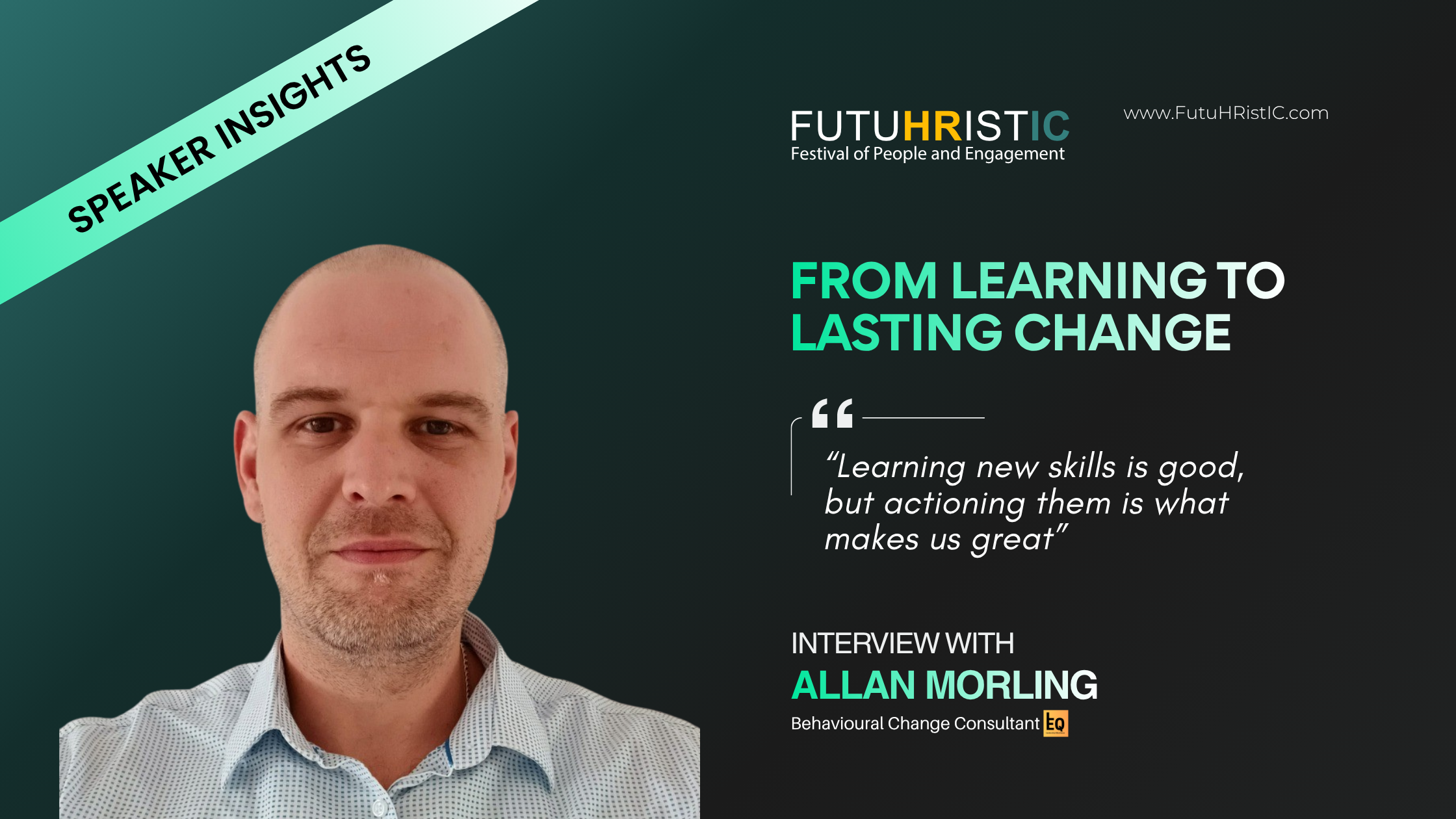
Speaker Insights: Allan Morling, Founder & Behavioural Change Consultant, Leadership EQcellence
As organisations continue to rethink leadership, culture, and employee development, one challenge remains remarkably consistent across industries: how do you ensure learning actually leads to lasting behavioural change?
At FutuHRistIC Festival 2026, The Festival of People & Engagement, HR, L&D, internal communications, leadership, and transformation professionals will come together in London for four days of conversations shaping the future of work. Through keynote sessions, interactive workshops, panel discussions, and collaborative networking, the festival explores the ideas, strategies, and human behaviours driving workplace transformation today.
In this edition of our Speaker Insights interview series, we speak with Allan Morling, Founder & Behavioural Change Consultant at Leadership EQcellence, whose workshop at the festival will focus on behavioural sustainment, leadership effectiveness, and why so much workplace learning struggles to create lasting impact.
With more than 15 years of experience in training and leadership development, Allan brings a practical and reflective perspective to one of the most important conversations facing organisations today: making learning stick.
We’re delighted to have you join us at the FutuHRistIC Festival 2026 this year. Your workshop will explore behavioural sustainment and leadership effectiveness within organisations. What key areas and challenges will you be focusing on during the session?
Thank you for having me. I am very much looking forward to delivering the session and being involved in the festival in general.
The behavioural gap has been a common problem within organisations for a very long time. One of the key elements I have seen over my 15-plus years in training is that the conditions are not in place for learning to stick. We will spend time on these conditions, exploring why they are so important and how an organisation or team can work to develop them.
Your workshop explores a challenge many organisations quietly struggle with, learning that feels impactful in the moment, but disappears afterwards. What first made you focus on this gap between learning and long-term behavioural change?
Having spent the last 5 years in corporate Learning and Development, I witnessed firsthand how the absence of the right conditions directly limits the potential for behavioural change.
I designed and developed leadership programmes that were exceptionally well received. The feedback was always excellent, but when I asked what had actually changed as a result, very little came back. What came back almost felt like lip service.
That disconnect was the moment I knew something was fundamentally missing. I want my training to be meaningful and for learning initiatives to be an investment and not an expense.
A lot of companies invest heavily in training and development, yet employees often fall back into old habits. In your experience, what are organisations still misunderstanding about how behaviour changes?
The misunderstanding almost always stems from misaligned perception. If two people stand opposite each other and one sees a 6 on the floor whilst the other sees a 9, neither is wrong; it is simply their perspective.
Organisations often believe the conditions for change are in place, when in reality their staff see something completely different. Beyond that, the ability to practise in a safe environment is critical, but the most overlooked piece is sustainment; it is rare that someone takes ownership of reinforcing the new behaviours or holding people accountable when there is a slip back into old habits.
One of the things that stands out in your approach is the idea of “behavioural sustainment” rather than simply learning delivery. How would you define that difference, and why does it matter so much now?
Behavioural sustainment is the missing piece of a jigsaw, in my opinion. The delivery has to be in place, and the conditions need to be in place within the session. People need to practise the skills they have learnt, but ultimately it is the ability to carry on with those behaviours that makes the difference.
You can learn all you want in a classroom, but unless you practise skills and apply them, they will never have a chance to be sustained. I tend to finish all sessions by saying, ‘Learning new skills is good, but actioning them is what makes us great.
Sustainment allows us to be held accountable and for us to be able to seek appropriate support.
Your sessions are described as practical, reflective, and discussion-led. What kind of conversations are you hoping to spark with attendees during the workshop?
I want to spark honest conversations about whether the conditions for behavioural change are truly in place, not just assumed to be. I want attendees talking to each other about the gaps between what leaders believe is happening and what their teams are actually experiencing.
The conversation I most want to ignite is around certainty: Do you actually know if your organisation has those conditions in place, and do you have the confidence to ask the questions that would tell you?
Leadership appears to be a central thread throughout your work. How much influence do leaders really have when it comes to whether learning becomes embedded in everyday workplace culture?
Leaders have an enormous influence! In fact, without their alignment, sustained behavioural change is almost impossible. If colleagues are told to take more time and care over decision-making, but a leader is pressuring everyone for a quick answer, the modelling is completely misaligned, and people will slip back into old habits.
Equally, if leaders are not open to being challenged or acknowledging that someone else might have a better idea, psychological safety erodes, and the creativity and growth you need from your team will quietly disappear.
You also speak about psychological safety as a key condition for behavioural change. Why do you think that element is still overlooked in many organisational learning strategies?
I think it gets overlooked partly because it has become such a buzzword; it appears in almost every ED&I session and leadership conversation, which ironically can cause people to gloss over it rather than truly engage with it.
In learning strategies specifically, it tends to be treated as a tick-box topic rather than a live, measurable condition that either exists in a team or it doesn’t.
When I deliver sessions on it, my aim is to cut through that and help people genuinely see how it applies to them, recognise that it may take time to build and help them to understand that the reward far outweighs the effort.
One of the strengths of FutuHRistIC Festival 2026 is bringing together HR, L&D, culture, and transformation leaders from different industries. What value do you think comes from having these cross-industry conversations in the same room?
I have always had a firm belief that it is good to talk. I have worked in too many organisations where each team works in a silo, and it is detrimental to the individuals, teams and organisations.
Bringing everyone together to share their experiences, problems and wins allows us all to share best practices and to really make the working environment a better place for everyone. Only good things can come from these types of events.
For someone attending your workshop at the festival, what would you most like them to walk away reflecting on afterwards?
The confidence to find out if their organisation or team have the 5 conditions in place, and the only way to find out is to ask the questions and actively listen to what is given back as a response.
Beyond the workshop itself, you founded BehaviourShift™️ through Leadership EQcellence with a clear long-term vision in mind. What is the bigger change you ultimately hope to help organisations achieve through your work?
Making learning stick! I want teams and organisations to be able to apply my BehaviourShift framework and be confident that there will be sustained behavioural change because they followed the framework. Training becomes an investment and not an expense. Because great training means nothing if nothing actually changes.
About FutuHRistIC™ Festival
Since 2012, FutuHRistIC™ has been connecting people, culture, and communication. Now in its 12th year, this four-day London festival breaks down the silos between disciplines, bringing together the Reinventing HR Summit and the Internal Communications Conference. It is a collaborative space for forward-thinking people leaders and communication professionals to step away from day-to-day pressures, challenge ideas, and shape a more connected, human future of work.
With registrations now open, we invite professionals from across industries to join the conversations shaping the future of leadership, communication, culture, employee engagement, and organisational transformation.
Discover more about the festival, speakers, and programme updates at FutuHRistIC Festival.


