


The People Shaping the Conversation: Meet the Speakers Coming to FutHRustIC Festival 2026
The most useful conversations about work rarely begin with a single answer. They begin with people who have worked through difficult organisational questions, tested approaches in practice, challenged established assumptions and learned what happens when strategy meets the reality of employees, leaders and teams.
That is the thinking behind the speaker programme at FutHRustIC Festival 2026.
Taking place from 17–20 November 2026 in London, the four-day festival brings together professionals working across HR, Internal Communications, leadership, employee experience, learning and development, workplace culture and the future of work. The programme brings together perspectives from global organisations, public institutions, professional services, cultural organisations, technology companies and specialist consultancies.
The breadth of the speaker lineup matters because the challenges facing organisations rarely sit neatly within one function. Employee communication affects trust. Leadership affects culture. Learning affects capability. Organisational change affects engagement. Decisions around technology, mobility, wellbeing and workplace structures can all influence how people experience their organisation.
For professionals working in HR and Internal Communications, understanding those connections is increasingly important.
The FutHRustIC speaker programme reflects that reality. Rather than focusing on one definition of the future of work, it creates space for different disciplines and experiences to meet, compare approaches and examine the practical questions organisations are dealing with now.
Why the people behind the work matter
There is a difference between discussing an organisational challenge in theory and having responsibility for navigating it in practice.
The FutHRustIC 2026 speaker lineup includes people who have worked inside major organisations, advised leaders, developed people strategies, led communications functions, supported organisational change and worked directly with employees.
That range creates an important advantage for a professional conference. HR and Internal Communications professionals do not necessarily need another collection of abstract predictions. They need opportunities to understand how other practitioners approach familiar problems.
Questions such as these are rarely straightforward:
- How should leaders communicate during periods of change?
- How can internal communications become more relevant to employees?
- What does effective employee engagement look like in practice?
- How can organisations develop leaders who communicate well?
- How should organisations approach learning and development?
- What role does culture play when organisations are growing or transforming?
- How can people teams work effectively across international environments?
- Where should technology and new ways of working fit into the employee experience?
The speakers coming to FutHRustIC bring different answers, experiences and professional perspectives to these questions.
That diversity is particularly relevant because the boundaries between people, communication and organisational strategy are becoming increasingly connected.
Internal communications is becoming a leadership discipline
Internal Communications sits at the centre of many organisational conversations, but its role can vary significantly between organisations.
For some teams, the focus is primarily on information. For others, Internal Communications is closely involved in employee engagement, leadership communication, organisational change and culture.
The FutHRustIC programme reflects this wider role through speakers working directly in internal and employee communications.
Paddy Johnston, Internal Communications Consultant at Level Up Communications, brings specialist communications experience to the programme, while Shalini Gupta, Head of Internal Communications at Arup, and Brooke Hobson-Jones, working in Corporate Internal Communications at Landsec, offer perspectives from major organisations.
The programme also includes communications leaders working across different international and organisational contexts. Hala Al-Balushi, Internal Communication Manager at Omantel, Katharina Auer, Head of Internal, HSE, Suppliers & Partners Communications at Hitachi Energy, and Simona Radu, Global VP, Employee & Executive Communications at Schneider Electric, bring experience from organisations operating across complex environments.
Their presence highlights an important professional consideration: internal communication is not simply about producing messages.
Effective communication requires understanding the organisation, its people, its leadership structures and the context in which information is being received. The same message can have very different implications depending on what employees already know, what they trust and what they need from their leaders.
Jon Bates, working in Employee and Leader Communications at Microsoft, adds another perspective on the relationship between employee communication and leadership.
For communication professionals, this raises a practical question: are internal communications teams primarily delivering information, or are they helping organisations create understanding?
The distinction matters. Information can be distributed quickly. Understanding requires context, clarity and often conversation.
HR and Internal Communications need each other
People strategy and communication strategy are often discussed separately, yet employees experience them together.
An organisation might introduce a new people policy, restructure a team, change its working model or introduce a new development programme. HR may be responsible for the policy or programme, while Internal Communications helps explain it. But employees do not necessarily separate those functions in the same way.
They experience the result as part of their overall relationship with the organisation.
This is reflected in the range of HR and People professionals joining FutHRustIC.
Ahmed Salah, Global Head of Human Resources at Oxford Economics, brings a global HR perspective, while Magdalene Arthur, Senior People Partner at WHSmith, and David Hippolite, Senior People Partner at the Victoria and Albert Museum, represent people-focused roles within very different organisational environments.
Hannah Harrop, Head of HR, Security at OCS, and Emma Wilson-Wyer, Senior People & Impact Manager at KAEFER, add further perspectives on how people functions operate within specific organisational contexts.
These roles demonstrate why modern people work cannot be reduced to a single model.
A People Partner working in retail, a museum, security services or an engineering environment will encounter different workforce structures, operational realities and organisational priorities. The principles of good people practice may overlap, but implementation requires context.
For HR professionals, that creates an ongoing balancing act between consistency and relevance. Policies need to support organisational goals while still making sense to the people expected to work within them.
Communication plays a major role in that process.
Leadership communication is about more than delivering a message
Leadership is another major thread running through the FutHRustIC programme.
Louise Thompson, Leadership Coach, Speaker and former Director of Communications, brings together leadership development and communications experience. Allan Morling, Founder and Behavioural Change Consultant at Leadership EQcellence, approaches leadership through behavioural change.
Their perspectives sit alongside Rob Hosking, an international TEDx motivational speaker, and Dr Sujaya Banerjee, CEO of Capstone People Consulting.
Leadership communication is often treated as a question of presentation skills, but the more difficult challenge is consistency.
Employees pay attention not only to what leaders say, but also to what leaders prioritise, repeat and reinforce through their decisions.
That means communication cannot be completely separated from behaviour.
A leadership team can communicate a set of organisational values, for example, but employees will also assess whether those values appear in everyday decisions. Similarly, an organisation can announce a change programme, but confidence in that programme will depend partly on whether leaders provide clear explanations and continue communicating as the situation develops.
For communications and HR professionals, this makes leadership support a strategic responsibility.
Practical questions include:
- What do leaders need to understand before they communicate?
- Which messages should come from senior leadership?
- Where is dialogue more useful than broadcast communication?
- How should leaders respond when they do not yet have every answer?
- How can communication remain consistent across different leadership voices?
These are not purely communications questions. They sit at the intersection of leadership, culture, employee experience and organisational trust.
Employee experience is built through everyday interactions
Employee experience can sometimes sound like a broad concept, but its practical meaning is found in everyday interactions.
How does someone experience their first weeks in an organisation? How easy is it to access information? How does their manager communicate? Can they see opportunities to develop? What happens when organisational priorities change?
These experiences accumulate.
FutHRustIC brings together speakers whose roles touch different parts of that experience.
Nick Holmes, Vice President of Learning & Culture at Avalere Health, brings a perspective focused on learning and culture. Amber (Stoten) Douglas, Learning & Development Leader for the UK & Europe at IWG, offers another perspective on organisational development and capability.
Meanwhile, Vidya Murali, Director of Business Operations at Skyscanner, brings an operational perspective that sits alongside the more traditional HR and communications functions.
This variety is valuable because employee experience does not belong exclusively to HR.
Managers influence it. Communications influence it. Learning teams influence it. Operations influence it. Leadership influences it. Organisational systems and processes influence it.
The practical challenge for organisations is therefore to understand where these experiences connect.
A learning programme, for example, may be well designed but poorly communicated. A new employee initiative may be communicated effectively but difficult to access. A leadership message may be clear but contradicted by the employee’s experience of a process.
Looking at employee experience across these touchpoints can reveal problems that are difficult to see when each function operates independently.
Culture needs to be understood through behaviour
Organisational culture is another area where professional language can become disconnected from everyday reality.
Culture is often described through values, purpose statements or employee initiatives. Yet culture also emerges through repeated behaviours: how decisions are made, how people respond to mistakes, how leaders handle disagreement, how teams collaborate and what behaviours are recognised.
That is why behavioural change and people development are important parts of the FutHRustIC conversation.
Allan Morling’s work in behavioural change connects directly to this question, while Nick Holmes and Amber Douglas bring learning and development perspectives that consider how organisations build capability.
Fiona Yensen, former Head of Wellbeing at the UK Home Office and Founder of Twiga Training & Consultancy Ltd., adds another perspective through wellbeing and professional development.
The connection between culture and behaviour is particularly important for organisations attempting to make cultural change sustainable.
Changing a value statement is relatively straightforward. Changing the behaviours that employees experience every day is considerably more complex.
For HR and communications professionals, that means asking practical questions about reinforcement.
What happens after the campaign ends?
What do managers do differently?
How are new behaviours supported?
How are employees given opportunities to practise them?
What happens when organisational pressure makes old behaviours easier?
These questions move the discussion from culture as a statement to culture as an organisational practice.
Global organisations require local understanding
Several FutHRustIC speakers work in organisations with international operations or global responsibilities.
That brings another layer of complexity to HR and Internal Communications.
A message that works in one country may need to be adapted elsewhere. Employment practices differ. Cultural expectations differ. Regulatory environments differ. Communication preferences differ. Employees may also have very different relationships with their local leadership teams.
Tatiana Chagas, Senior Global Mobility & Immigration Specialist in International Employment at PM Group, brings a perspective focused on international employment and mobility.
Hala Al-Balushi, Simona Radu, Katharina Auer and others in the programme work within international organisations where communication and people practices need to function across multiple contexts.
For global teams, the challenge is often finding the right balance between central direction and local relevance.
A completely centralised approach can miss local realities. A completely decentralised approach can create inconsistency.
The solution is rarely simply choosing one or the other. Instead, organisations need to identify which elements genuinely need global consistency and where local teams should have room to adapt.
That is as much a communication challenge as an operational one.
Technology, law and the changing workplace
The future of work conversation also extends beyond traditional HR and communications topics.
Technology is changing how organisations operate, while regulation and legal questions are creating new considerations for employers and employees.
Sylvie Delacroix, Inaugural Jeff Price Chair in Digital Law at King’s College London, brings a legal and academic perspective to the programme.
Her presence broadens the conversation around the workplace by introducing questions about how digital developments intersect with law, organisations and society.
This is increasingly relevant for HR and communications professionals because new technologies often create questions that cannot be answered by one department alone.
When organisations introduce new digital tools, for example, they may need to consider employee communication, training, data, governance, legal responsibilities and workplace culture at the same time.
Understanding those connections can help professionals move beyond viewing technology simply as a tool.
The more useful question is often how technology changes the way people work, communicate, collaborate and make decisions.
Reputation, trust and communication are connected
The speaker programme also includes professionals whose work sits at the intersection of communications, governance and organisational reputation.
Terri Duhon, Non-Executive Director and Risk Chair at Wise and Rathbones, brings board-level experience in risk and governance.
Nicole Bearne, Founder & Director of The Comms Exchange Ltd and iNED at Motorsport UK, brings communications and governance experience.
These perspectives are particularly relevant when considering how organisations respond under pressure.
Internal and external reputation are often discussed separately, but employees are also audiences. They see organisational decisions, experience their consequences and form their own interpretations.
During periods of uncertainty, internal communication therefore becomes part of organisational resilience.
Employees need information they can understand, but they may also need clarity about what is known, what is changing and what remains uncertain.
That requires communication professionals to work closely with leadership and other functions rather than treating communication as the final stage of decision-making.
A programme built around different professional perspectives
One of the defining features of the FutHRustIC 2026 lineup is the range of professional backgrounds represented.
Alongside HR, Internal Communications and leadership specialists, the programme includes people working across wellbeing, behavioural change, learning, international employment, business operations, digital law, governance and communications.
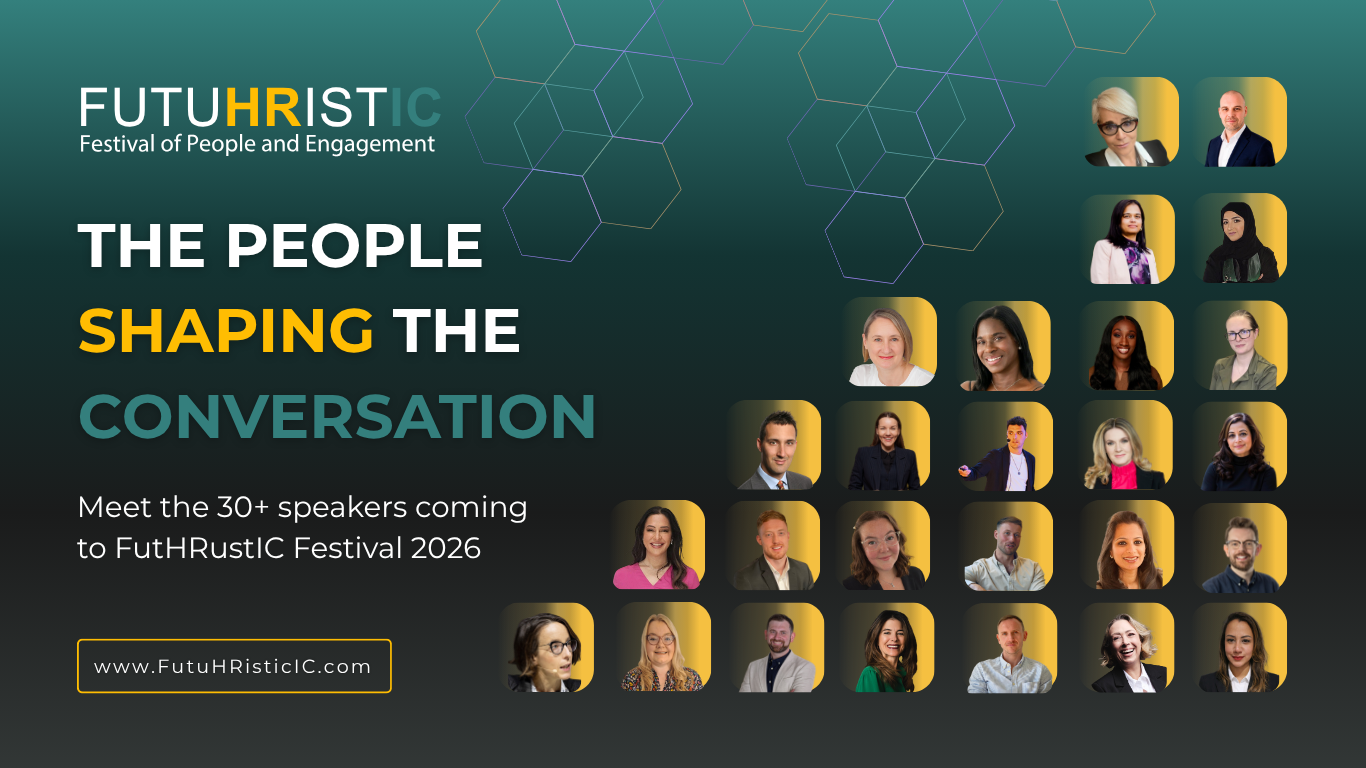
The speaker list includes:
- Fiona Yensen, former Head of Wellbeing, UK Home Office and Founder of Twiga Training & Consultancy Ltd.
- Paddy Johnston, Internal Communications Consultant, Level Up Communications.
- Ahmed Salah, Global Head of Human Resources, Oxford Economics.
- Jan Freygang, former Recruiter at Disney.
- Nick Holmes, Vice President, Learning & Culture, Avalere Health.
- Magdalene Arthur, Senior People Partner, WHSmith.
- Allan Morling, Founder & Behavioural Change Consultant, Leadership EQcellence.
- Terri Duhon, Non-Executive Director and Risk Chair, Wise and Rathbones.
- Shalini Gupta, Head of Internal Communications, Arup.
- Rob Hosking, International TEDx Motivational Speaker.
- Louise Thompson, Leadership Coach, Speaker and former Director of Communications.
- Brooke Hobson-Jones, Corporate Internal Communications, Landsec.
- Vidya Murali, Director, Business Operations, Skyscanner.
- Jon Bates, Employee and Leader Communications, Microsoft.
- Hala Al-Balushi, Internal Communication Manager, Omantel.
- Tatiana Chagas, Senior Global Mobility & Immigration Specialist, PM Group.
- Hannah Harrop, Head of HR, Security, OCS.
- Amber (Stoten) Douglas, Learning & Development Leader, UK & Europe, IWG.
- Emma Wilson-Wyer, Senior People & Impact Manager, KAEFER.
- David Hippolite, Senior People Partner, Victoria and Albert Museum.
- Howard Krais, Co-Founder, True.
- Nicole Bearne, Founder & Director, The Comms Exchange Ltd and iNED, Motorsport UK.
- Simona Radu, Global VP, Employee & Executive Communications, Schneider Electric.
- Dr Sujaya Banerjee, CEO, Capstone People Consulting.
- Katharina Auer, Head of Internal, HSE, Suppliers & Partners Communications, Hitachi Energy.
- Sylvie Delacroix, Inaugural Jeff Price Chair in Digital Law, King’s College London.
- Esther Kuku, Director of Communications and Engagement, Resuscitation Council UK.
- Natasha Liedl-McDowall, Internal Communication Partner to Operations, LSEG.
Together, they represent different organisations, functions and professional experiences. That makes the programme less about one prescribed approach and more about exposing professionals to the different ways people and organisations are tackling shared challenges.
What professionals can take from the conversation
A conference programme becomes useful when the ideas discussed can be taken back into the workplace.
For HR and Internal Communications professionals attending FutHRustIC, some of the most useful questions to carry through the four days may be relatively simple:
Where are we treating communication as a delivery function when it should be part of decision-making?
Where are our employee experience problems actually process or leadership problems?
Which behaviours are we trying to change, and what reinforces them today?
Are our people strategies connected to what employees actually experience?
Where do global approaches need local adaptation?
How well equipped are our leaders to communicate uncertainty, change and difficult decisions?
What would we do differently if we designed our employee experience around the whole journey rather than individual initiatives?
These questions do not require a single answer. Their value is in helping professionals examine their own organisations with greater clarity.
That is also why a diverse speaker programme can be useful. A perspective from Internal Communications may change how an HR professional thinks about a people initiative. A leadership discussion may give a communications professional a different way to approach executive communication. A behavioural change perspective may challenge assumptions about culture.
The value is often found in the connection between disciplines.
Frequently Asked Questions
What is FutHRustIC Festival 2026?
FutHRustIC Festival 2026 is a four-day professional festival focused on HR, Internal Communications, employee engagement, leadership, workplace culture, employee experience and the future of work.
When does FutHRustIC Festival 2026 take place?
FutHRustIC Festival 2026 takes place from 17–20 November 2026 in London, UK.
Where is FutHRustIC Festival 2026 held?
The festival takes place in London, UK, bringing together professionals working across HR, Internal Communications and related people and workplace disciplines.
Who is speaking at FutHRustIC 2026?
The speaker programme includes HR leaders, Internal Communications professionals, leadership coaches, behavioural change consultants, learning and development specialists, communications leaders and experts working across international employment, governance, digital law and employee experience.
Which topics will be covered at FutHRustIC?
Topics represented across the programme include Internal Communications, HR, employee engagement, leadership, organisational culture, learning and development, wellbeing, behavioural change, employee experience, international employment and the future of work.
Is FutHRustIC relevant to Internal Communications professionals?
Yes. The programme includes professionals working specifically in Internal Communications and Employee and Leader Communications, alongside HR and leadership specialists whose work intersects with employee communication.
Is FutHRustIC relevant to HR professionals?
Yes. The speaker lineup includes Global Heads of HR, People Partners, HR leaders, Learning & Development professionals and specialists working across people and organisational functions.
Why are HR and Internal Communications discussed together?
HR and Internal Communications frequently work on connected organisational challenges, including employee engagement, organisational change, leadership communication, culture and employee experience. Bringing the disciplines together allows professionals to consider these issues from different perspectives.
What can professionals gain from attending FutHRustIC?
The festival provides an opportunity to hear different professional perspectives, examine practical approaches to people and communication challenges, and connect with professionals working across HR, Internal Communications, leadership and workplace culture.
How many speakers are taking part in FutHRustIC 2026?
The festival programme features 30+ speakers across four days, representing a range of organisations, functions and professional backgrounds.
How can I register for FutHRustIC 2026?
Registration is available through the official FutHRustIC website: https://futuhristic.com/registration/
Bringing the conversation together
The strongest professional conversations rarely stay within one department.
A question about employee engagement can quickly become a question about leadership. A communication challenge can reveal a culture issue. A learning programme can influence employee experience. A change initiative can expose weaknesses in organisational communication. A new technology can create questions about training, governance, communication and workplace behaviour at the same time.
That is why the range of voices at FutHRustIC Festival 2026 matters.
Across four days in London, professionals will have the opportunity to hear from people who approach these challenges from different positions and different areas of expertise. The goal is not to provide one universal model for how organisations should operate, but to create a space where experienced professionals can compare ideas, question assumptions and take useful thinking back to their own organisations.
30+ speakers. Four days. One festival bringing HR and Internal Communications into the same conversation.
FutHRustIC Festival 2026 takes place from 17–20 November in London.
Meet the speakers, explore their perspectives and join the conversation.
Register now: https://futuhristic.com/registration/


