


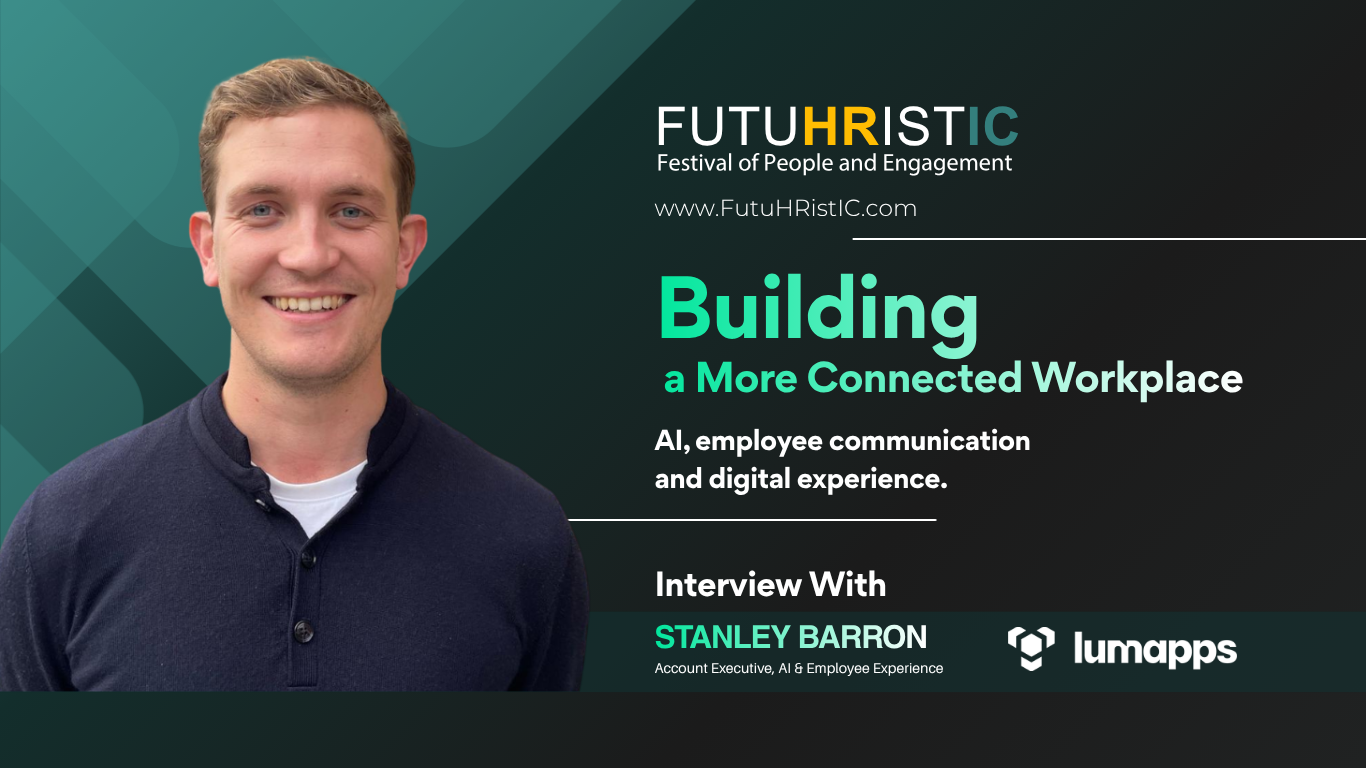
Building a More Connected Workplace: An Interview with LumApps
What does it take to create a more connected workplace where employees can access the right information and use AI effectively?
For Stanley Barron, Account Executive, AI & Employee Experience at LumApps, the answer starts with reducing digital friction and making workplace technology work for people. Ahead of his appearance at FutuHRistIC Festival 2026, he shares how organisations can improve employee communication, increase engagement and adopt AI in practical ways that make a difference to everyday work.
LumApps helps organisations connect employees with the information, communication and tools they need through a unified digital workplace. By combining personalised experiences, integrated workflows and practical AI capabilities, the platform supports organisations in reducing information overload, improving accessibility and creating a more connected employee experience.
From your conversations with organisations, what is the biggest employee communication challenge leaders should be paying attention to today, and what happens when it goes unresolved?
The biggest challenge facing leaders today is digital friction caused by fragmented communication tools and an increasingly complex technology landscape. Many organisations rely on a mix of communication platforms, HR portals and productivity tools, forcing employees to navigate disconnected applications throughout the working day.
When workplace communication is fragmented, important messages get lost, information becomes harder to access and employees are more likely to experience disengagement and digital fatigue. Addressing this challenge requires a more connected digital employee experience that brings communication, information and everyday tasks together.
From your conversations with organisations, what is the biggest employee communication challenge leaders should be paying attention to today and what happens when it goes unresolved?
The single biggest challenge facing leaders today is digital friction and message fragmentation across an increasingly complex technology landscape. Modern enterprises often operate with a chaotic mix of communication tools, HR portals, and productivity platforms, forcing employees to switch between disconnected applications daily. When left unresolved, this digital friction leads directly to information silos, critical announcements getting lost in the noise, employee disengagement, and widespread digital burnout.
Many organisations invest in communication tools but still struggle with engagement. What separates a platform employees actively use from one they largely ignore?
The distinction lies in moving from a passive corporate intranet to an active, personalised employee hub. Platforms that employees ignore are typically top-down, static repositories that require manual searching. In contrast, an engaging platform acts as a unified digital front door delivering role-tailored content, integrating daily workflows, micro-apps, and actionable tasks directly into the employee’s routine so they can get work done efficiently in one place.
With employees facing constant messages, updates and notifications, how can Internal Communications teams earn their attention without adding to the overload?
IC teams must move away from blanket broadcasting and embrace smart, audience-based personalisation. By leveraging advanced profiling, targeted newsletters, and AI-driven content recommendations, communications are tailored to specific roles, locations, and interests. This ensures employees receive only high-value, highly relevant information in their preferred channel whether web, mobile app, or digital signage cutting through noise without overwhelming them.
Where can stronger collaboration between HR and Internal Communications make the greatest difference to employees’ everyday experience?
The greatest synergy occurs across key employee milestones, such as onboarding, career development, and employee recognition. When HR and IC align using integrated digital journeys, new hires experience seamless, structured onboarding with automated tasks, curated learning, and clear cultural messaging. Combining recognition initiatives with internal news further amplifies corporate values and boosts retention.
Frontline and deskless employees can be among the hardest to reach. What approaches have you seen work, and what can other organisations learn from them?
Successful organisations meet frontline workers where they are by deploying fully branded native mobile applications alongside digital signage in shared operational spaces. Providing seamless, passwordless or mobile SSO authentication alongside quick-access micro-apps such as shift scheduling, leave requests, and instant peer recognition—ensures frontline workers feel connected to corporate culture and empowered in their daily work.
Researchers have cautioned organisations against AI for the sake of novelty, urging IC leaders to focus on practical, permission-aware AI. How is AI being integrated into platforms in a way that actually reduces friction?
Practical AI focuses on solving real workplace friction rather than generating superficial content. Through permission-aware AI search, enterprise-grade governance, and contextual assistants, employees can instantly retrieve trusted, accurate information across connected repositories (like Microsoft 365 or Google Workspace) respecting existing user access rights. AI also streamlines content creation with automatic translation, content summarisation, and automated tagging for IC teams.
During organisational change, employees need clarity and trust. How can digital tools help leaders listen, respond and keep people involved throughout the process?
Digital tools foster trust by enabling transparent, two-way communication channels during transformations or strategic pivots. Dedicated community spaces, interactive leadership blogs, video messaging, and real-time pulse feedback or sentiment analysis allow leaders to listen directly to employee concerns. Leaders can quickly address questions through Q&A forums, keeping teams aligned and informed as changes unfold.
Could you share a practical example of how LumApps has helped an organisation improve employee connection? What were the measurable results, and what lessons could our delegates apply in their own workplaces?
LumApps worked with a global enterprise featuring a hybrid mix of desk-based and frontline workers to consolidate disparate communication tools into a single branded employee hub. By implementing personalised news feeds, mobile app access, and integrated micro-apps, the organisation achieved over 85% platform adoption within months, dramatically increased frontline engagement, and reduced internal email volumes while providing measurable insights into content performance and sentiment.
For leaders who need to demonstrate the value of internal communications, which measures help build a convincing case for investment beyond views and clicks?
Building a business case requires connecting communications to tangible business outcomes. Beyond basic page views, leaders should track active adoption across workforce segments (especially frontline), content readership completion rates, task completion speed via micro-apps, sentiment changes over time, user journey analytics, and reductions in 90-day new-hire churn resulting from streamlined onboarding processes.
As LumApps joins FutuHRistIC Festival 2026, what conversations are you most looking forward to having with delegates, and what practical insights can they expect to take away from your session?
We look forward to discussing how HR and IC leaders can eliminate digital friction, unite desk and frontline teams, and apply practical, permission-aware AI to everyday workflows. Delegates will take away actionable frameworks for building a unified digital front door, strategies to boost mobile adoption among frontline workers, and methods for demonstrating true ROI on employee experience investments.
What role does a modern intranet play in supporting organisational change during major strategic shifts or M&As?
During major strategic shifts or M&As, a modern intranet acts as the central anchor for cultural alignment and operational unification. It provides a single source of truth for corporate announcements, facilitates rapid onboarding and integration of new teams, offers dedicated hubs for leadership Q&As, and helps harmonise disparate systems and workflows under one clear, trusted employer brand.
Yes or No: Is ‘tool sprawl’ across the likes of Microsoft 365, Google Workspace, and HR tools currently the single biggest friction point for employee digital productivity?
Yes. Tool sprawl creates fragmented employee experiences, causes constant context-switching, and hides critical information across disconnected applications. An orchestration layer is essential to bring these productivity systems together seamlessly into a unified front door.
Yes or No: Should content creators be automatically asked to review and re-certify their published intranet pages after a set time period to prevent information decay?
Yes. Automated content lifecycle governance and re-certification workflows are crucial to maintain platform trust, ensuring outdated or inaccurate information is systematically flagged, updated, or archived.
Yes or No: Is asking employees to switch between 10+ disconnected workplace apps every day actively driving digital burnout?
Yes. Constant context-switching increases cognitive fatigue and reduces productivity. Unifying daily tools, notifications, and workflows into a central hub directly mitigates digital burnout.
Yes or No: Should UK C-suite leaders be expected to post updates and engage directly with employees on the company intranet rather than hiding behind corporate memos?
Yes. Authentic executive visibility fosters organisational trust, boosts engagement, and creates open dialogue across all levels of the business.
Yes or No: Is a modern intranet now a key tool for UK HR directors trying to reduce 90-day new-hire churn?
Yes. Providing clear, structured onboarding journeys and immediate connection to company culture significantly improves new-hire satisfaction and retention during the crucial first 90 days.
As LumApps joins FutuHRistIC Festival 2026, Stanley Barron will share practical insights into how organisations can reduce digital friction, connect employees and make better use of AI in the workplace. His session, “What Are the New Best Practices with AI?”, will explore where AI stands today in HR and Internal Communications, what makes it useful for employees and how organisations can get started with confidence.


