


Speaker Insights: Howard Krais, Co-Founder, True
As workplaces continue to evolve through transformation, digital disruption, and shifting employee expectations, organisations are being challenged to rethink not only how they communicate, but how they listen.
At FutuHRistIC Festival 2026 – The Festival of People & Engagement, leaders from HR, internal communications, employee engagement, transformation, and culture will come together in London to explore the future of work through practical insight, cross-industry conversations, and forward-thinking leadership discussions.
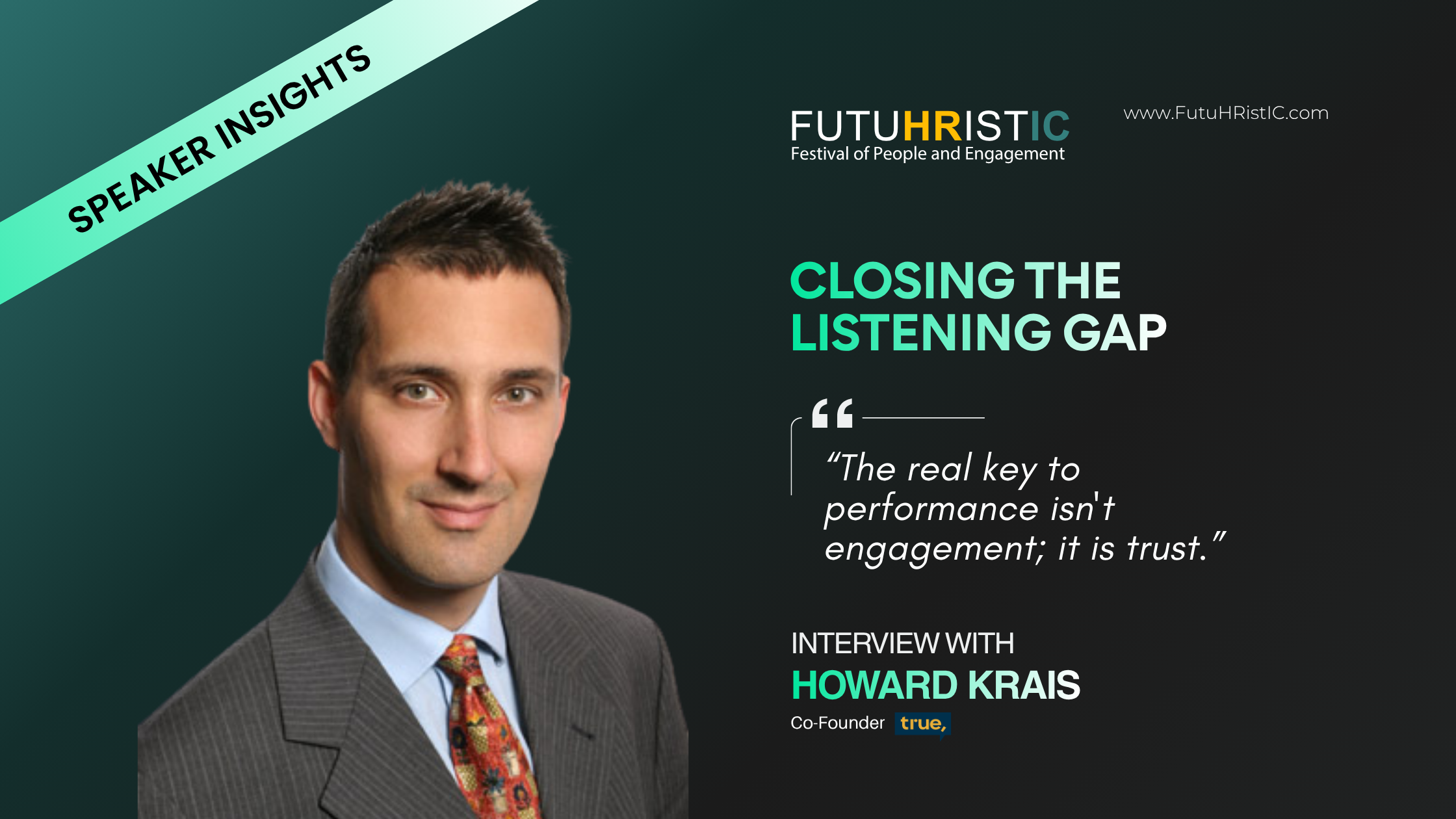
In this edition of our Speaker Insights interview series, we speak with Howard Krais, Co-Founder of True Communications, whose workshop session at the festival will explore organisational listening, people-centred change, employee trust, and the evolving role of communication in modern organisations.
With nearly 30 years of experience across organisations, including EY, GSK, and Johnson Matthey, Howard has built a global reputation for helping organisations approach communication, engagement, and transformation through a more human-centred lens. He is also co-author of Leading the Listening Organisation and a recognised international speaker on communication, culture, and organisational change.
We’re delighted to have you join us at the FutuHRistIC Festival 2026 this year. Your work focuses on organisational listening, employee engagement, and the role of communication in driving meaningful change. What key themes and conversations will you be exploring during your session?
For my session, I’ll explore why we have officially entered a new era for internal communications that I call ‘The Age of Listening.’ I’ll set out how this shift will radically redefine our purpose as communicators, the value we deliver, and the strategic role we play in the future of business.
Specifically, we will define what genuine organisational listening looks like, map out its overwhelming business case, and introduce the concept of organisational intelligence, something that moves us past standard box-ticking data collection and turns employee insights into decision-grade strategic information that leaders can act on.
You’ve built an extensive career across global organisations, including EY, GSK, and Johnson Matthey, working at the heart of internal communication and transformation. What first drew you towards the world of organisational communication and employee engagement?
Like many others, I fell into the world of internal communications – it certainly wasn’t a planned career move. I mean, who had even heard of internal comms back then?
It was the mid-1990s (obviously, I was only 12 at the time) while working at NatWest, and I found myself in a true ‘sliding doors’ moment as I was offered three distinct options for my next move: project management, change management, or communicating the change.
I chose the communications route because it sounded creative and fun. For example, I was instantly handed responsibility for the bank’s internal video output. Despite not knowing one end of a camera from the other, I suddenly found myself working with professional film crews and people I recognised from the TV.
Alongside the video ‘Glamour’, I was also given responsibility for an early feedback channel called ‘The Hotline’. Staff could phone in, listen to a recorded message from the CEO, and leave a question with a promise of a response within 48 hours. It was successful and trusted, and looking back, it was my very first nudge in my journey around organisational listening.
A lot of organisations talk about “listening to employees,” but your work strongly challenges how genuinely that happens in practice. In your experience, what does effective organisational listening actually look like beyond the traditional feedback mechanisms?
Too many leaders tick the listening box simply because they know the organisation carries out a regular survey or supports employee networks. But processes don’t listen; people do.
For me, genuine organisational listening requires three things: hearing the employee voice, processing it, and then responding appropriately. Both these words are non-negotiable. If an organisation runs a survey but fails to report the results for say three months (not uncommon), that is a response, but it isn’t an appropriate one. By then, employees have moved on, checked out, and chalked up another waste of their time.
Ultimately, organisational listening is no different from personal listening. In our daily lives, we instantly know when someone is paying attention to us or not. When they do, we feel valued and ‘seen.’ When they don’t, it’s insulting and frustrating. It is the same when an employer raises the possibility of listening. If nothing happens as a result, employees simply stop trying.
Change programmes are often well-designed at the leadership level but fail to resonate with employees on the ground. Where do you think communication typically breaks down in large-scale transformation initiatives?
There are so many reasons, but the biggest is that leaders can often suffer from what we might call ‘change amnesia.’ They spend the time necessary going through their own journey to get a business case approved, but the moment it is signed off, they assume their teams will instantly embrace the ‘blinding logic’ of their thinking.
At True, our guiding principle is what we call ‘people-centred change’, which we define simply as doing change with people, rather than to them.
To deliver a successful transformation, leaders must recognise that human reactions to change are rarely logical. Neuroscience shows us that our brains process change emotionally first, naturally craving predictability and routine. The moment an announcement is made, the employee asks the questions that matter most to them, for example: ‘What does this mean for me?’ and ‘Will I still have a job?’
To bring people with you, you need to allow people to have the right conversations, giving employees the psychological safety to ask their questions, raise their concerns, and share ideas. This is what builds genuine understanding.
Once people feel the organisation has truly listened and responded to their issues, they are much more likely to give the change a chance. If you skip this step, this is where you hit costly rework, missed deadlines, and plummeting morale.
You co-authored Leading the Listening Organisation, which places listening at the centre of organisational success. What inspired that thinking, and what gap did you see in how organisations approach communication and culture?
The journey toward Leading the Listening Organisation actually began from a place of concern on behalf of the internal communicator. It was a pre-COVID world of increasing cost pressures, which, amongst other things, meant teams were being squeezed, and there were big crackdowns on travel. I worried that too many communication teams were becoming trapped in head offices, disconnected from their frontline audiences who might be scattered across the globe, doing a range of different roles in different places. How can you possibly know what people are thinking or how they are responding to your messaging if you don’t step into their reality?
To investigate this gap, I teamed up with my research partners, Mike Pounsford and Kevin Ruck. Over the next few years, we conducted a rigorous series of four consecutive studies, moving from best-practice deep dives and a major global survey to online focus groups.
As our data grew, we realised that the true potential of listening extended far beyond the communications function. It was a massive, untapped lever for leadership and business performance. That insight became the foundation of our book. We understood that true organisational listening isn’t a soft HR or communications initiative; it is a hard strategic discipline that closes the gap between executive assumption and frontline reality. And in fact, it is even more than that.
Employee engagement is often treated as a metric, but your work suggests it is much more complex and human than that. How should organisations rethink the way they define and measure engagement today?
This might sound controversial coming from someone who has spent decades in this field, but I simply do not believe in ‘engagement’ anymore.
For years, the industry has defined engagement as creating the conditions for teams to give more of their ‘discretionary effort.’ Reflecting on what I see with the reality of modern workplaces, I am no longer convinced that is how it works.
Furthermore, I don’t think that most executives really understand or, frankly, care about engagement scores. They might pay attention to the data for a month or two after the annual survey reports, but employee engagement scores are rarely treated with the same strategic focus as financial or productivity metrics.
The real key to performance isn’t engagement; it is trust. If an employee trusts their organisation and their manager, they are far more likely to accept ongoing change, feel a genuine sense of belonging, and actively contribute to the company’s success. I think we need to stop chasing arbitrary engagement percentages and start measuring the health of the trust contract between leaders and the frontline.
You’ve worked with organisations navigating large-scale change across different industries and geographies. What patterns or common mistakes do you see when it comes to how organisations communicate transformation?
One of the biggest mistakes we make is focusing our communication on the wrong groups of people. Organisations often pour much of their energy into securing the buy-in of the most senior executive team. But executives aren’t the ones driving daily adoption. The real heavy lifting is done by a wider or extended leadership group. These are the people who manage the big teams and bridge the gap between corporate strategy and frontline action. If you don’t bring this wider leadership group into the tent early, your transformation will stall.
Similarly, as communicators, we often fall into the trap of having the objective of delivering change to 100% of the workforce simultaneously. That is an impossible task, and it’s a strategy no marketer or external communicator would ever use.
Instead of treating the employee base as a monolith, our task should be to segment our audiences ruthlessly. We need to identify the key functional groups and hidden influencers who hold the most sway over their peers. By focusing our efforts there, we get the biggest ‘bang for our buck’ and allow organic momentum to drive the change across the rest of the business.
One of the strengths of FutuHRistIC Festival 2026 is bringing together leaders across HR, transformation, operations, and strategy. What value do you think comes from aligning these perspectives when thinking about communication and culture?
Transformation is entirely a team sport. As a communicator, I often view our role as that of a conductor. We aren’t playing every instrument, but we are helping all the different parts of the business stay in sync and own their piece of the change.
Whenever I’ve led major transformation initiatives, the highest value has always come from building deep, collaborative partnerships with leaders across HR, operations, and strategy. Each function holds a different piece of the puzzle. When you align these perspectives, you eliminate organisational blind spots and ensure your strategy isn’t compromised by executive assumptions. When HR, operations, and communications are all pointing in the same direction, executing a culture shift becomes infinitely easier, faster, and more sustainable.
Looking ahead, how do you see the role of organisational communication evolving as workplaces become more distributed, digital, and shaped by AI-driven tools?
We must stop viewing AI as a threat to our jobs. In fact, I believe it is a huge opportunity. Too many internal communication professionals are trapped in the ‘content hamster wheel’, constantly feeding hungry channels and fending off demanding stakeholders. When I speak to teams about people-centred change or strategic listening, they often look back at me, and you can see the thought running through their minds, ‘That sounds wonderful, but when would I ever have the time?’
AI is the tool that gives us that time back. By deploying AI agents to handle the high-volume, transactional content needs of the business, we can radically increase our efficiency. This frees us up to focus more on our listening. Crucially, AI also gives us the analytical horsepower to process what we are hearing quickly, turning raw sentiment into the decision-grade intelligence leaders crave.
Ultimately, AI will be the catalyst that transitions internal communication from an administrative execution and process-based function into an indispensable, data-driven strategic advisory.
For someone attending your session at the festival, what would you most like them to walk away thinking differently about when it comes to listening, communication, and organisational change?
If I can land just one message, it is that the future of internal communication isn’t about building better megaphones; it is entirely about listening.
We don’t need to listen simply because it’s the ‘right thing to do’ or because we are nice people. We need to listen because it positions the communication function in a completely different light. It is through deep, systematic listening that we capture the strategic insights and organisational intelligence required to help us deliver change better, predict risk, and drive better executive decisions.
AI is the tool that will accelerate this transition. If we embrace it, then there is an incredibly bright, indispensable future ahead for our profession.”
About FutuHRistIC™ Festival
Since 2012, FutuHRistIC™ has been connecting people, culture, and communication. Now in its 12th year, this four-day London festival breaks down the silos between disciplines, bringing together the Reinventing HR Summit and the Internal Communications Conference. It is a collaborative space for forward-thinking people leaders and communication professionals to step away from day-to-day pressures, challenge ideas, and shape a more connected, human future of work.
With registrations now open, we invite professionals from across industries to join the conversations shaping the future of leadership, communication, culture, employee engagement, and organisational transformation.
Discover more about the festival, speakers, and programme updates at FutuHRistIC Festival.


