


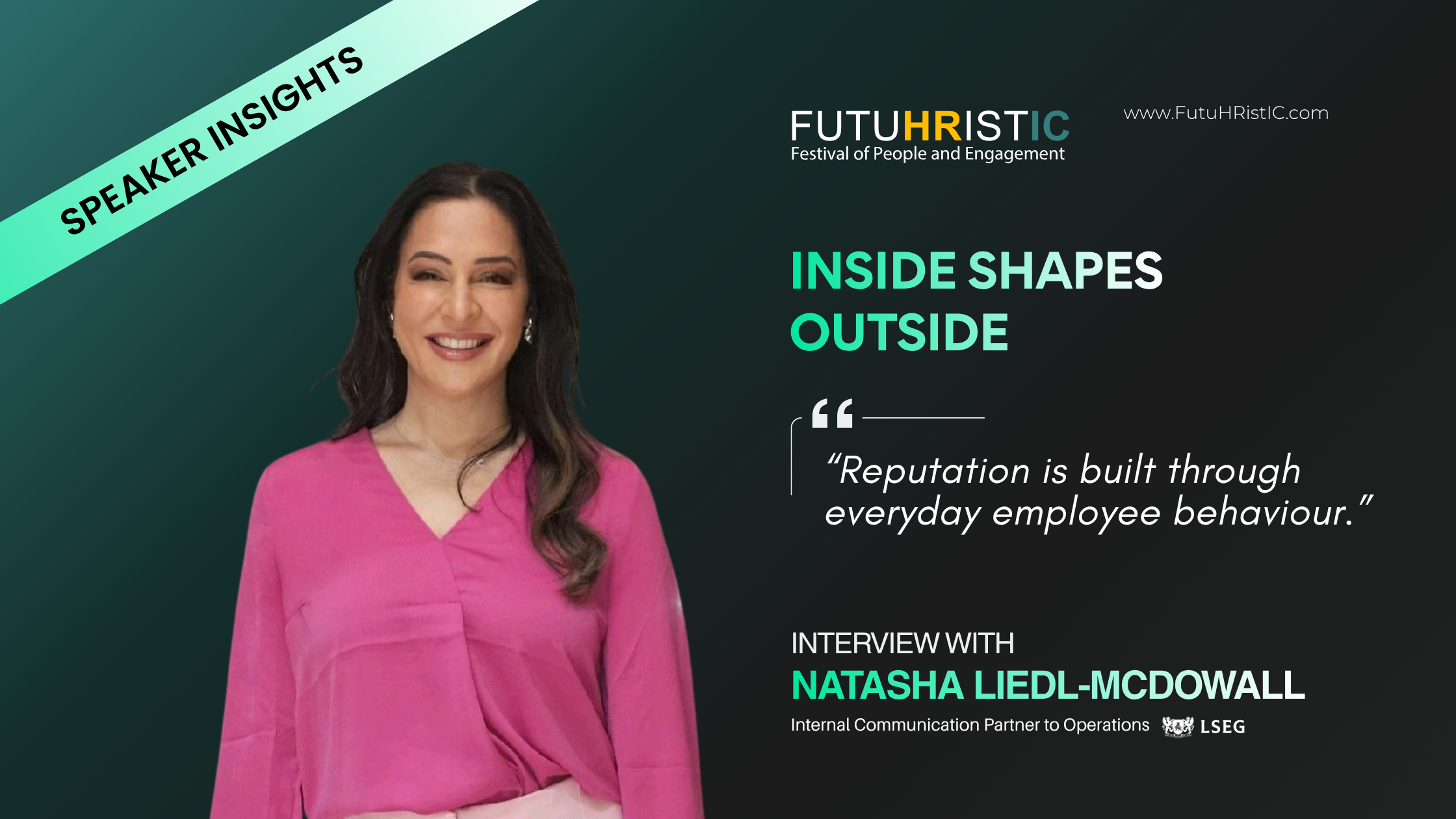
Speaker Insights: Natasha Liedl-McDowall, Internal Communication Partner to Operations, LSEG
As organisations navigate increasing complexity, transformation, and evolving employee expectations, internal communication is becoming a critical driver of organisational performance, culture, and reputation. While many businesses continue to focus on external brand perception, forward-thinking leaders recognise that reputation is built from the inside out through the experiences, behaviours, and engagement of employees.
At FutuHRistIC Festival 2026, The Festival of People & Engagement, HR, talent acquisition, leadership, communications, and transformation professionals will come together in London for four days of conversations shaping the future of work. Through keynote sessions, interactive workshops, and collaborative networking, the festival explores the strategies, leadership approaches, and employee experiences helping organisations create stronger cultures and more connected workplaces.
In this edition of our Speaker Insights interview series, we speak with Natasha Liedl-McDowall, Internal Communication Partner to Operations at LSEG. Originally trained as a television journalist and a wellness business owner, Natasha has built an impressive career spanning technology, data and analytics, operational services, and global communications. Having engaged with audiences across more than 190 countries and worked closely with frontline teams throughout the UK, she is a passionate advocate for internal communication as a strategic function that strengthens culture, influences behaviour, and protects organisational reputation from within.
We’re delighted to have you join us at the FutuHRistIC Festival 2026 this year. Your work sits at the intersection of internal communication, culture, and organisational reputation. What are some of the key themes and conversations you’ll be exploring during your session?
I’ll be exploring how what happens inside an organisation shapes what happens outside it. Trust, clarity and performance matter every day, and this is where internal communication ensures employees love their company so their customers do. At its best, internal comms helps people understand where the organisation is going, why it matters, and what is expected of people when the environment is complex, fast-moving or uncertain.
I’ll also be talking about how we influence outcomes. Employees don’t engage with operating models simply because communication materials exist. They engage when leaders are credible, messages are clear, and communication helps them make sense of change. That is where internal communication earns its place as a strategic function, rather than just producing a steady stream of well-intentioned content.
You’ve said that employees must love a company before its customers can. That’s a powerful perspective in today’s workplace climate. What first shaped your belief that internal communication has such a direct impact on organisational reputation and culture?
That belief was shaped very early in my career when I worked with frontline employees at Veolia in the UK. I spent time with refuse collection teams, not just writing about their work but joining them on their rounds to understand their world properly. What struck me was that these were colleagues making daily decisions that shaped how the public experienced the brand.
I heard story after story of colleagues helping members of the public, returning lost property, assisting people across the road, or simply treating others with care and dignity while on their rounds. Those moments generated praise, goodwill and measurable impact on brand perception.
It was a clear lesson: reputation is built through everyday employee behaviour. Internal communication has a direct role in shaping that behaviour by reinforcing pride, purpose and connection. Customers notice more than organisations sometimes realise.
Many organisations still treat internal communication as something operational rather than strategic. In your experience, what are companies still underestimating about the influence internal communication can have on employee engagement and business performance?
Many organisations still underestimate two things.
First, internal communication provides a real-time view of sentiment, understanding and friction points in a way annual surveys can’t. Done well, it gives leaders an earlier read on what people are hearing, what they are questioning and where confidence is wobbling. That matters in any business, but especially in complex organisations navigating change at pace.
Second, the function is still too often measured by activity rather than impact. Views, clicks and attendance have their place, but senior leaders rightly want to know what changed as a result. Did understanding improve? Did behaviour shift? Did confidence in leadership increase?
Internal communication becomes strategic when it connects its work to business outcomes, not just channel metrics.
Your background is particularly unique, from television journalism to now leading internal communications within global organisations while running a wellness business. How have those different experiences shaped the way you approach communication and leadership today?
My background has given me a broader lens on communication and leadership. Journalism taught me how to find the real story, ask better questions and stay calm when the first version of an issue is rarely the full version. That is invaluable in internal communication, particularly in large organisations where leaders are often making decisions in real time, and employees need clarity and context.
Running a wellness business has shaped me differently. It has made me more intentional about how people experience work, leadership and pressure. I bring that perspective into how I lead teams and advise stakeholders. High performance is important, but sustainable high performance is what creates lasting impact.
Together, those experiences have made me interested in the human side of organisational life. Internal communication sits at the intersection of strategy, storytelling, culture and leadership.
Having worked with audiences across more than 190 countries, as well as frontline operational teams across the UK, you’ve seen workplace communication from both global and local perspectives. What differences or common challenges stand out most to you across those environments?
Everyone is human, and everyone is seeking honesty, connection, belonging and leadership they can trust. That is true whether you are communicating with a global corporate population or a local frontline team.
What changes is the context. In global organisations such as LSEG, you need a clear central narrative that can travel across markets, functions and cultures without becoming overly abstract.
The difference is in the nuance. Local audiences need communication that reflects their operational reality, cultural norms and practical concerns. Global messages can set direction, but local credibility comes from showing people you understand the environment they are working in.
The art is creating consistency while respecting local differences. This ensures the global narrative is relevant to people’s roles so they relate to it, and an emotional connection is born.
Throughout your career, you’ve built internal communication functions from the ground up and transformed them into trusted advisory partners. What does it take for internal communication teams to move from being seen as “support functions” to becoming strategic voices within an organisation?
Internal communication teams need to move beyond being seen as a delivery service and position themselves as advisers. That means being comfortable asking important questions, challenging unclear thinking and helping stakeholders focus on what will create the most value. Senior credibility comes from judgement as much as responsiveness.
Teams need to prove their value in language the business will listen to. At the executive level, the focus is on whether communication helped leaders land a change, improve understanding, increase confidence or reduce resistance, and much less on whether a channel had a particularly strong week.
The shift happens when internal communication combines judgement, commercial awareness and evidence-based reporting and is brave enough to challenge seniority to ensure the audience is represented and their voice is brought to the table.
An executive once said to me: “If you’re not causing arguments and having disagreements, you’re not solving the big problems.”
I believe we need to be better at communicating how we impact business performance. Typically, in my experience, internal communications doesn’t advocate for itself effectively. We have a tendency to people-please, which leads to pushed boundaries, burnt-out teams, and delivering communications that add little value.
We earn the trusted adviser badge by demonstrating impact, advising leaders honestly, and anticipating issues before others see them. I’m passionate about this because I’ve experienced a few blows to get us to this status. I’ve learnt courage and to swallow my discomfort to do the right thing.
Technology and organisational transformation are moving faster than ever, particularly within operations-focused businesses. How do you think internal communication needs to evolve in order to keep employees connected and engaged during periods of constant change?
Employees are operating in a noisy environment with limited attention and very little patience for jargon. During periods of transformation, communication cannot simply increase in volume. More messages rarely create more understanding. Quite often, they just create a more crowded inbox.
The function also has to help leaders communicate with more clarity and confidence, equip managers better, and make it easier for people to understand what matters now, what is changing and what it means for them.
In organisations like LSEG, where change can be strategic, operational and regulatory all at once, that discipline is essential.
Managers remain the most important source of information, clarity and direction for most teams, which is why supporting them matters so much.
Internal communication also has a role in creating the conditions for psychological safety by making it easier for leaders to share lessons learned, acknowledge when things have not gone to plan, and encourage open conversation.
Employees do not expect perfection. They do, however, notice when honesty is missing.
One of the recurring conversations around the future of work is around trust, transparency, and authenticity inside organisations. Do you think employees today expect something fundamentally different from leadership communication compared to previous generations?
Yes, I do think expectations have shifted. Employees now expect leadership communication to be faster, more direct and more human.
People are used to hearing from public figures, brands and commentators in real time, so highly scripted corporate communication can feel distant very quickly. They naturally expect leaders to be more visible and accessible, too.
That does not mean leaders need to become social media personalities, which is probably best for everyone. But it does mean the bar for openness has moved.
I’m a huge advocate of internal social media for its ability to cross boundaries, encourage open conversation and enable leaders to interact with their people in their own time. I actively ensure our executives are responding to comments, not just broadcasting through posts. Engagement and conversations are two-way.
Employees want leaders to answer difficult questions directly, acknowledge what they know and what they do not, and communicate with honesty and consistency. They want leaders to be more human and vulnerable so they are believed and people feel they are acting for them, not against them.
A major strength of FutuHRistIC Festival 2026 is bringing together HR, culture, communications, and transformation leaders from different industries into one space. What value do you think comes from having those cross-functional and cross-industry conversations together?
HR, communications, culture and transformation leaders are often trying to solve the same organisational problems from different angles, and organisations move faster when those disciplines stop operating in silos.
When they work together, you reduce friction, improve decision-making and create a more coherent employee experience. It is also generally less expensive than untangling disconnected decisions later, which tends to sharpen attention quite quickly.
Looking beyond the festival itself, what bigger shift would you ultimately like to see happen within the corporate world when it comes to how organisations communicate with and value their people?
I would like to see organisations value communication and people leadership as core infrastructure, not optional extras.
Too many businesses invest heavily in systems, processes and transformation plans, but not always enough in the leadership and communication needed to help those changes land well.
I would also like to see more support for managers, because they remain the most important communication channel in most organisations. If we want employees to feel informed, supported and connected to change, managers need the confidence and capability to lead those conversations well and be given the space to do it.
For internal communicators, that means bringing judgement, evidence and a clear point of view with confidence. The function creates the most value when it helps organisations communicate with greater clarity, consistency and trust, and saves everyone from a great deal of avoidable noise.
About FutuHRistIC™ Festival
Since 2012, FutuHRistIC™ has been connecting people, culture, and communication. Now in its 12th year, this four-day London festival breaks down the silos between disciplines, bringing together the Reinventing HR Summit and the Internal Communications Conference. It is a collaborative space for forward-thinking people leaders and communication professionals to step away from day-to-day pressures, challenge ideas, and shape a more connected, human future of work.
With registrations now open, we invite professionals from across industries to join the conversations shaping the future of leadership, communication, culture, employee engagement, and organisational transformation.
Discover more about the festival, speakers, and programme updates at FutuHRistIC Festival.


