


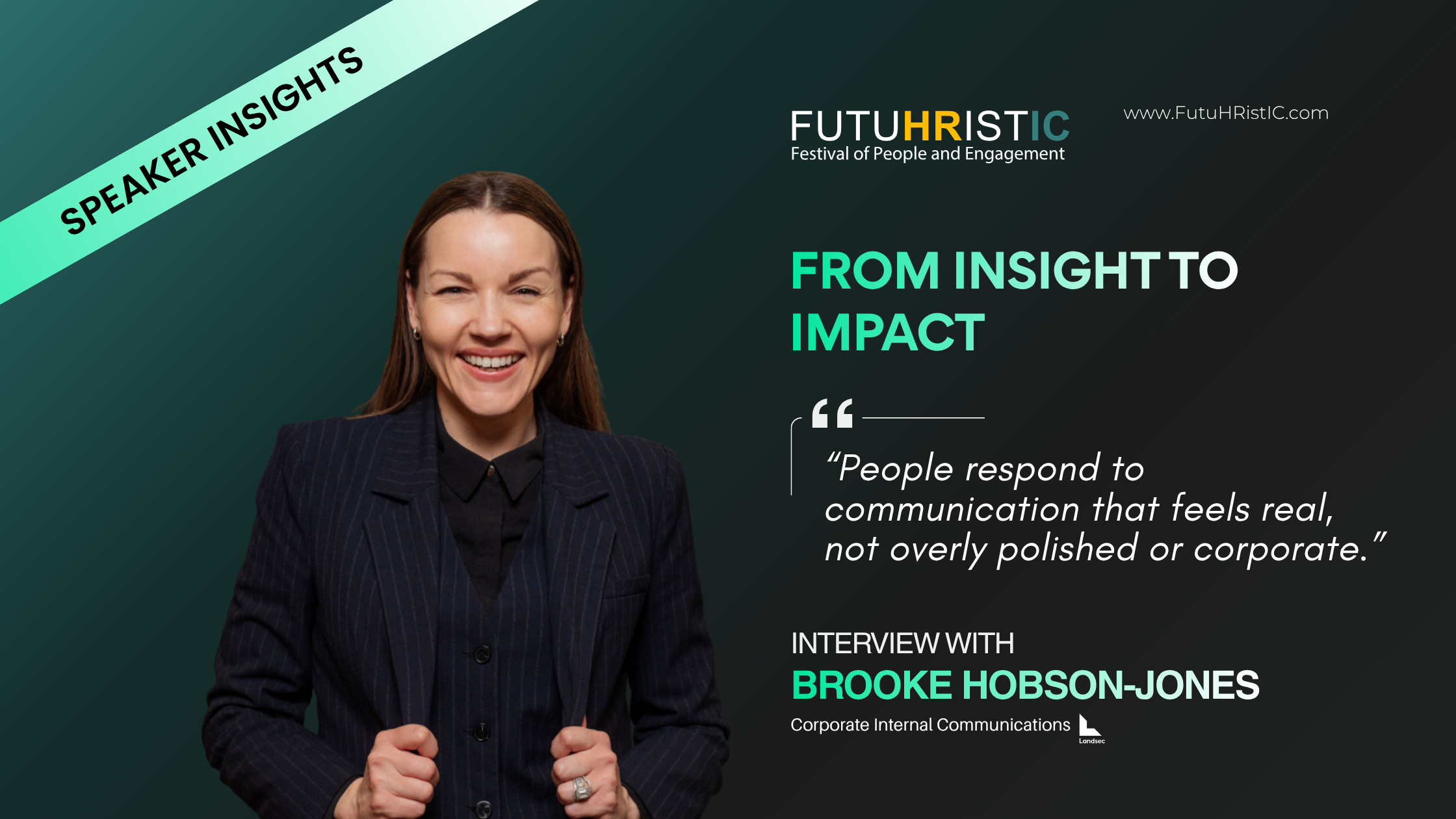
Speaker Insights: Brooke Hobson-Jones, Corporate Internal Communications, Landsec
As organisations continue navigating transformation, evolving employee expectations, and increasingly digital ways of working, internal communication has become far more than a channel for sharing information. Today, it plays a central role in shaping culture, enabling leadership, strengthening employee engagement, and helping organisations translate strategy into action.
At FutuHRistIC Festival 2026, The Festival of People & Engagement, HR, talent acquisition, leadership, communications, and transformation professionals will come together in London for four days of conversations shaping the future of work. Through keynote sessions, interactive workshops, and collaborative networking, the festival explores the strategies, technologies, and human experiences driving workplace transformation today.
In this edition of our Speaker Insights interview series, we speak with Brooke Hobson-Jones, Corporate Internal Communications at Landsec. Brooke leads internal communications for one of the UK’s leading FTSE 100 real estate organisations, with a £10 billion portfolio spanning retail, leisure, and workplace destinations across the country. With experience across retail, real estate, operations, and corporate communications on three continents, Brooke brings a commercially grounded and people-centred perspective to leadership communication, culture, employee engagement, digital transformation, and organisational performance.
We’re delighted to have you join us at the FutuHRistIC Festival 2026 this year. Your work spans internal communications, leadership engagement, culture, and digital transformation within one of the UK’s leading real estate organisations. What key themes and conversations will you be exploring during your session?
I’ll be focusing on the shift from internal communication as a service function to a genuine driver of business impact.
Too often, communication is seen as something that sits around the edges of strategy, when in reality it should be central to how organisations engage their people, navigate change, and ultimately perform. In the session, I’m looking forward to exploring how we move from insight to impact in a practical way. That includes how we better connect internal communication with HR and business priorities, how we measure what matters, and how we ensure leaders are equipped to communicate with clarity and confidence, especially during periods of change.
The conversation is about moving beyond outputs and channels and focusing on the role internal communication can play in shaping culture, building trust, and driving meaningful business outcomes.
Your career has taken you across retail, real estate, operations, and corporate communications on three different continents. How have those varied experiences shaped the way you approach communication, leadership, and employee engagement today?
Working across different industries and geographies has given me a broader perspective on what good communication looks like in practice, but also where it often falls short.
In operational roles, particularly in retail, you’re very close to the frontline. You quickly learn that communication only works if it’s clear, relevant and easy to act on. That’s really stayed with me. It’s shaped a very practical approach where I’m always asking: does this help someone do their job better, or make a decision with more confidence?
Moving into real estate and corporate communications has added another layer, particularly around complexity and scale. You’re balancing strategic priorities, multiple audiences and often significant change. That’s where strong leadership, communication and alignment with HR become critical.
Working across different cultures has also reinforced how important it is to listen and adapt. There’s no one-size-fits-all approach to engagement. It’s shaped a style that is people-led but commercially grounded. Communication needs to drive clarity, alignment and performance, but it should feel human too.
Internal communication has evolved significantly over the past few years, particularly in large and fast-moving organisations. In your experience, what are businesses still underestimating about the strategic role internal communication can play?
One of the biggest things organisations still underestimate is just how central internal communication is to turning strategy into action. It’s often treated as a channel or an output when in reality it plays a critical role in how work actually gets done.
There’s also a tendency to underestimate the role internal communication can play in shaping leadership capability. In complex organisations, people look to leaders for clarity, context and direction, but many aren’t equipped or supported to communicate effectively. That’s where internal communication can add real value, not just in crafting messages, but in enabling leaders to connect, listen and respond in a way that builds trust and alignment.
Another area is employee voice and insight. Businesses gather a huge amount of data, but the gap often sits in translating that insight into visible action. Internal communication has a unique role as the connector – linking what employees are saying to what leaders do next and making that connection visible to drive engagement and credibility.
Finally, I think the shift from outputs to outcomes is still underestimated. It’s not about how much we communicate, but whether it creates clarity, alignment and momentum. When internal communication is embedded early in business and HR planning, it becomes a strategic enabler – helping organisations move faster, navigate change more effectively, and deliver better results.
You work closely with senior leaders to translate complex business priorities into communication that feels clear and engaging for employees. What do you think makes leadership communication truly effective during periods of change or uncertainty?
For me, effective leadership communication during change comes down to clarity, consistency, credibility, and creating space for conversation.
In periods of uncertainty, people are looking for simple, honest answers. Not just what is happening, but why it matters and what it means for them. Leaders don’t need to have all the answers, but they do need to provide context and direction. That shared understanding is what helps people navigate change with confidence.
Consistency is also critical, particularly in larger organisations where messages can become fragmented as they cascade. If leaders aren’t aligned, it creates confusion and slows down decision-making and execution. Supporting leaders with clear narratives and practical tools helps ensure the message lands in a consistent way across the organisation.
Credibility is the third piece. Communication is as much about behaviour as it is about messaging. People look at what leaders do just as much as what they say. When communication is open, visible and backed up by action, it builds trust, even in difficult moments.
Finally, it’s about creating space for dialogue. The most effective leaders don’t just communicate with people; they listen, create space for conversation, and adapt.
Your remit includes culture, employer brand, and employee engagement alongside communication strategy. How interconnected do you think those areas have become in shaping the overall employee experience?
I think these areas have become very interconnected, to the point where it’s hard to separate them meaningfully.
Culture, employer brand and employee engagement are all shaped by the everyday experiences people have at work, and internal communication plays a central role in connecting those experiences together. It’s how strategy is translated into something people understand, how leaders show up, and how values are made real in practice.
Where I still see a gap in some organisations is in treating these areas as standalone initiatives. You might have a strong employer brand externally, but if the internal experience doesn’t reflect that, it quickly loses credibility. The same applies to culture. It isn’t just defined by what you say; it’s shaped by what people see and experience every day.
When these areas are aligned, that’s when you start to see a real shift. Communication reinforces culture, culture strengthens engagement, and that in turn becomes a much more authentic employer brand.
For me, it’s about taking a more joined-up, experience-led approach. Thinking less about individual campaigns or channels and more about how everything comes together to create a consistent, meaningful experience for colleagues.
You’ve also worked extensively in crisis and issues communications, supporting leaders during high-pressure moments. What are some of the biggest lessons organisations can learn about communication when trust and clarity matter most?
Crisis situations really shine a light on the role communication plays in building or eroding trust. When things are moving quickly and there’s a high degree of uncertainty, the quality of communication becomes even more visible.
One of the biggest lessons is the importance of being clear and timely, even when you don’t have all the answers. Silence creates a vacuum, and people will fill that with speculation. It’s far better to acknowledge uncertainty, share what you do know, and commit to regular updates. That sense of openness goes a long way in maintaining trust.
Another key lesson is consistency. In complex organisations, messages can easily become distorted as they trickle through multiple layers, which creates confusion at exactly the point people need clarity most. Having a clear narrative and supporting leaders to communicate it consistently is critical.
There’s also a strong human element. In high-pressure situations, how leaders show up really matters. People are looking for visibility, empathy and honesty. Communication isn’t just about information; it’s about reassurance and connection as well.
Listening becomes even more important, too. Crisis communication shouldn’t be one-way. Creating space for feedback and responding to concerns in real time helps organisations stay connected to what people are actually experiencing and adapt accordingly.
At its core, effective communication in these moments comes down to trust. And trust is built through clarity, consistency, visible leadership and a genuine willingness to listen and adapt.
Digital workplace transformation continues to reshape how employees connect and collaborate. How can organisations ensure communication remains human and meaningful while relying more heavily on digital channels and technology?
Digital channels and technology have transformed how quickly and widely we can communicate, but they also bring a real risk of communication becoming transactional or impersonal if we’re not careful.
For me, the starting point is recognising that technology is an enabler, not the outcome. The focus still needs to be on the employee experience. Just because we can communicate more frequently or more widely doesn’t mean we always should. It’s about being intentional with what we share and making sure it’s relevant, clear and genuinely useful.
Keeping communication human comes down to tone and authenticity. People respond to communication that feels real, not overly polished or corporate. That’s especially important in digital environments where nuance can easily be lost. Ensuring leaders show up in a visible and personal way, whether that’s through video, live sessions or written updates that feel like how they actually speak, makes a big difference.
There’s also an important balance between scale and connection. Digital platforms allow us to reach large audiences quickly, but they should be complemented with opportunities for dialogue. Creating space for interaction, questions, and feedback helps maintain that sense of connection, rather than communication feeling one-way.
I think simplicity is key. The more digital channels you introduce, the easier it is for communication to become fragmented or overwhelming. A more considered, “fewer, bigger, better” approach helps cut through the noise and ensures the messages that do land have real impact.
At its best, digital transformation should make communication more accessible, more inclusive and more engaging, but it’s the human element that ultimately determines whether it connects.
One of the recurring conversations around the future of work is the importance of inclusion, belonging, and people-centred leadership. What role does internal communication play in creating cultures where employees genuinely feel connected and valued?
Internal communication plays a really central role in creating cultures where people feel connected and valued, but it’s important to recognise that it’s not the whole answer on its own. It’s an enabler of those outcomes, working alongside leadership behaviour, culture and the wider employee experience.
At its best, internal communication creates clarity and shared understanding. It helps people see how their role connects to the bigger picture, which is a big part of building a sense of purpose and belonging. When people understand where the organisation is heading and how they contribute, they’re far more likely to feel engaged and connected.
It also plays a key role in amplifying employee voice. Feeling heard is fundamental to inclusion. Communication gives people a platform to share their perspectives, and just as importantly, it helps make visible how that feedback is being listened to and acted on. That transparency is what builds trust and helps people feel valued rather than just informed.
There’s also a strong connection with leadership. Effective internal communication supports leaders to communicate in a way that is open, consistent and human. That visibility and authenticity is what helps create environments where people feel safe to contribute and be themselves.
I also think consistency matters. Inclusion and belonging aren’t built through one-off campaigns or moments, they’re shaped through everyday communication. The stories we tell, the voices we amplify, the moments we choose to (and not to) recognise – all of that contributes to how people experience the organisation.
Internal communication connects strategy to experience, gives people a voice, and helps create the conditions where individuals feel seen, heard and valued.
Beyond your corporate work, you’re also passionate about mentoring and supporting others in the profession. Why do you think mentorship and knowledge-sharing are so important within communications and leadership today?
I think mentorship and knowledge-sharing have always been important, but they feel even more critical now given how our profession is evolving. The challenges organisations and the people within them face are becoming more complex, and no one has all the answers.
For me, mentoring creates space for honest conversations. It allows people to share challenges, sense-check ideas and build confidence, which is especially important in a profession that often sits in the middle of competing priorities. It’s not just about giving advice; it’s about helping people think differently and navigate situations in a way that works for them.
Knowledge-sharing is equally important. One of the strengths of the internal communications community is how open people are about sharing what’s worked, but also what hasn’t. That collective experience helps raise the standard of the profession and avoids people having to reinvent the wheel.
I’ve also seen firsthand the impact it can have on leaders. Initiatives like reverse mentoring create opportunities for leaders to hear perspectives they wouldn’t normally be exposed to, which can be incredibly powerful in shaping more inclusive and informed decision-making.
More broadly, both mentoring and knowledge-sharing help build stronger connections across organisations and across the profession. They create a culture of continuous learning, which ultimately benefits individuals, teams and the business as a whole.
One of the strengths of FutuHRistIC Festival 2026 is bringing together leaders from HR, communications, culture, transformation, and leadership into the same space. What would you most like for attendees to walk away reflecting on after your session?
What I’d really like people to walk away reflecting on is just how interconnected all of these areas have become. Internal communication, HR, culture, transformation and leadership can’t operate in isolation anymore. The reality is that employees experience all of these things as one joined-up journey, not as separate functions or initiatives.
When those areas are aligned, that’s when organisations really make progress. You see stronger clarity, more consistent leadership, better engagement and ultimately better performance. But when they’re disconnected, it creates fragmentation and makes it much harder for people to understand priorities or feel genuinely connected to the organisation.
So, I’d hope attendees leave thinking about how they can work more collaboratively across those areas, bringing people, communication, strategy and business priorities closer together. Because that’s where the real opportunity sits. Not in doing more activity within silos, but in creating a more aligned, more intentional experience that helps people understand where the organisation is going, how they contribute, and why it matters.
About FutuHRistIC™ Festival
Since 2012, FutuHRistIC™ has been connecting people, culture, and communication. Now in its 12th year, this four-day London festival breaks down the silos between disciplines, bringing together the Reinventing HR Summit and the Internal Communications Conference. It is a collaborative space for forward-thinking people leaders and communication professionals to step away from day-to-day pressures, challenge ideas, and shape a more connected, human future of work.
With registrations now open, we invite professionals from across industries to join the conversations shaping the future of leadership, communication, culture, employee engagement, and organisational transformation.
Discover more about the festival, speakers, and programme updates at FutuHRistIC Festival.


