



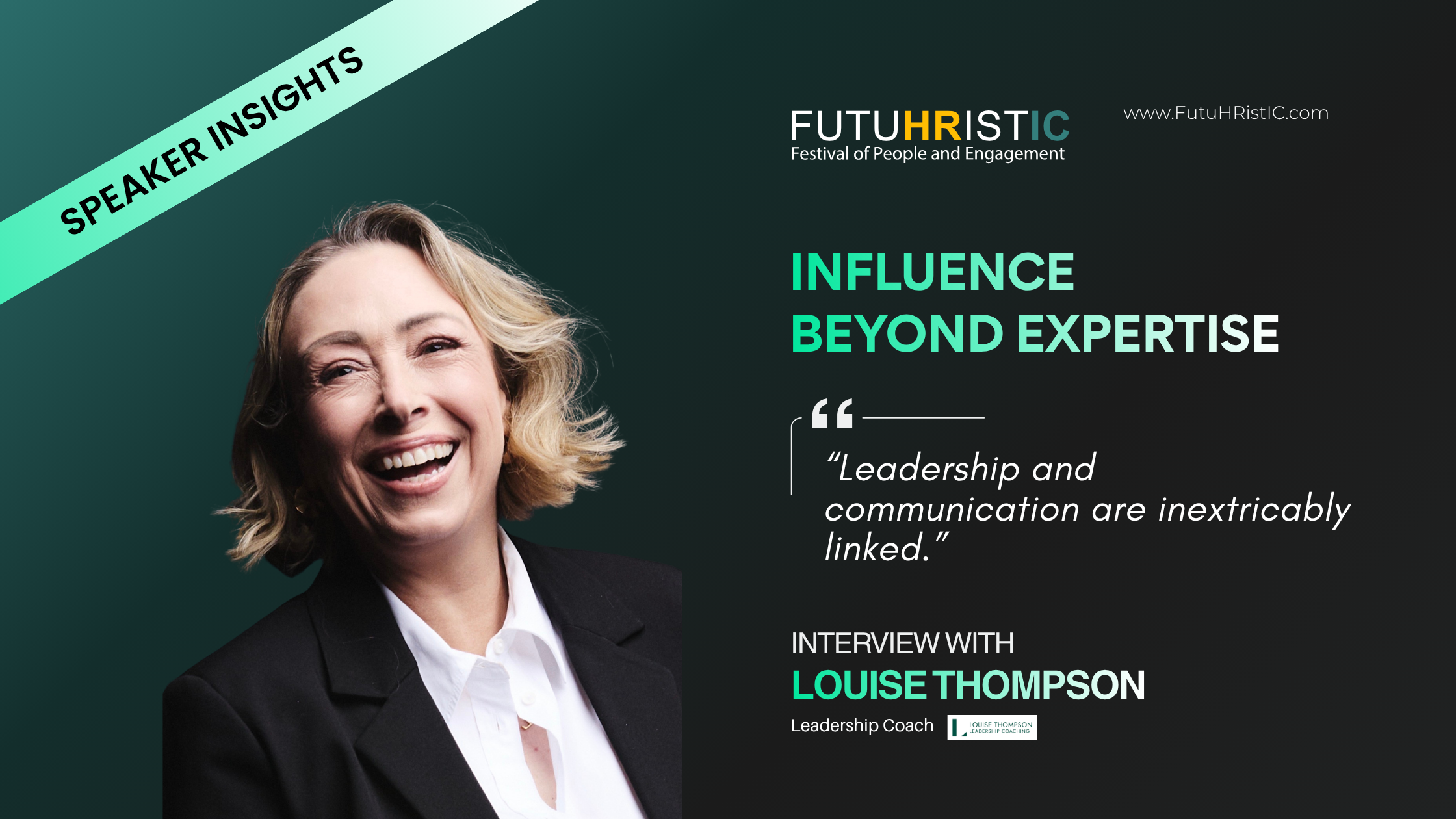
Speaker Insights: Louise Thompson, Leadership Coach, Louise Thompson Leadership Coaching
As organisations navigate constant transformation, growing stakeholder expectations, and increasingly complex workplace dynamics, communication has become one of the defining leadership capabilities of our time. Whether leading change, building trust, influencing decision-making, or aligning people around a shared vision, the ability to communicate strategically is no longer confined to communications teams; it sits at the heart of effective leadership itself.
At FutuHRistIC Festival 2026, The Festival of People & Engagement, HR, talent acquisition, leadership, communications, and transformation professionals will come together in London for four days of conversations shaping the future of work. Through keynote sessions, interactive workshops, and collaborative networking, the festival explores the leadership behaviours, communication strategies, technologies, and human experiences driving workplace transformation today.
In this edition of our Speaker Insights interview series, we speak with Louise Thompson, Leadership Coach at Louise Thompson Leadership Coaching. Louise brings more than 20 years of experience spanning Silicon Valley start-ups, global organisations, and senior board-level communications leadership within the NHS. Having advised on national transformation programmes, health advocacy initiatives, and large-scale communications campaigns, she now works globally with senior communications professionals, helping them strengthen their influence, leadership presence, and impact at the highest levels of organisations.
We’re delighted to have you join us at the FutuHRistIC Festival 2026 this year. Your career spans senior communications leadership across Silicon Valley start-ups and major public sector organisations, including the NHS, before moving into leadership coaching. What key themes and conversations will you be exploring during your session?
The session is built around a question I hear constantly from senior communications professionals: I know I deserve a seat at the table, so why does it still feel so hard to claim it? We’re going to get honest about what’s actually getting in the way. Not confidence as an abstract concept, but the specific structural and behavioural patterns that keep capable, experienced communicators operating below their actual authority. Expect a direct conversation about visibility, influence, and what it really takes to be treated as a strategic partner rather than a competent “safe” pair of hands.
You’ve led communications in two very different worlds, fast-moving Silicon Valley start-ups and large-scale public sector organisations like the NHS. What first drew you to strategic communications, and what did those contrasting environments teach you about leadership and influence?
I fell into communications the way a lot of people do; I wanted to be a journalist! But I quickly found the world of Comms and PR to provide a lot of the fulfilment and purpose I was looking for in journalism – storytelling, writing and an instinct for narrative, translating complicated concepts into language that actually connected to people and moved them. What kept me working in Comms was the strategic dimension. Working agency-side and then in-house with tech startups in Silicon Valley taught me that in fast-moving, high-stakes environments, communications isn’t a support function; it’s a driver of the business and of growth. Moving into the NHS was a different kind of complexity, slower in some ways, politically far more intricate, with much higher human stakes. What both environments taught me is that leadership and communication are inextricably linked. You can’t lead well without communicating well. And many comms professionals need to work on this in their own careers.
Much of your work has involved board-level advisory within the NHS, including national campaigns and transformation programmes. What are some of the biggest challenges leaders face when communicating change at that level of complexity?
Leading communications nationally for nursing in the NHS gave me a front-row seat to this. The biggest challenge isn’t messaging; it’s the gap between what leaders think they’ve communicated and what people on the ground have actually heard and understood. At a national scale, in an organisation as vast and varied as the NHS, that gap can be enormous. The second challenge is trust. Change communication in complex public sector environments lands very differently depending on whether people believe the organisation is being straight with them. You can have a technically brilliant communications strategy, and it will fail if the underlying trust isn’t there. And the third, which doesn’t get talked about enough, is the courage to communicate honestly when the news isn’t good.
In your experience, what separates communications that genuinely shift behaviour and build alignment from those that simply inform or broadcast messages?
Broadcast communication tells people what’s happening. It assumes that information equals change. It almost never does. What shifts behaviour is communication that makes people feel seen in their specific reality, that connects the change to something they actually care about, and that gives them a believable role in it. It’s about meeting people where they are and listening – really listening – to how they feel. The organisations that do this well treat communications as a two-way sense-making and engagement process, not a delivery mechanism. The ones that do it badly are usually measuring broadcast outputs.
You now coach senior communications professionals globally. What are the most common barriers that hold experienced leaders back from increasing their influence at the top level of organisations?
Three things come up consistently with my coaching clients all over the world. First, over-functioning – doing more and more excellent work at the level they’re already at, hoping it eventually gets noticed at the level above. It doesn’t work that way. Second, a reluctance to advocate visibly for their own perspective. There’s often a deeply conditioned belief that if the work is good enough, it will speak for itself. It won’t. And third, a tendency to stay in the expert “functional” lane rather than stepping into the advisory lane. Being the best communicator in the room is not the same as being the person who shapes how the organisation thinks. The shift from one to the other is significant, and most comms professionals haven’t been told explicitly that it’s even a shift they need to make. I know I wasn’t, and I struggled with the transition from functional comms expert to organisational leader as a result, and worked with a coach. The rest is history!
Having worked across both the UK and US, how have you seen expectations around leadership presence and communication style differ between Silicon Valley and public sector environments?
In Silicon Valley, there is a premium on speed, directness, and the kind of confidence that is the ability to hold a room, move fast, and project certainty even when you don’t feel it. There’s less hierarchy in some respects, but often a very particular unspoken culture about who gets taken seriously and why. (Very common in founder-led cultures.) The NHS is almost the inverse in some ways – deeply hierarchical, highly relational, with a strong undercurrent of vocation that shapes everything, including how leadership is expressed. What I took from moving between those worlds is that leadership presence isn’t just one thing. It’s contextual. The leaders who are genuinely influential across different environments aren’t the ones who’ve perfected a style; they’re the ones who read the room accurately and know how to adapt without losing their actual point of view.
Trust is often described as the foundation of effective leadership communication. How do organisations begin to rebuild trust when it has been lost or weakened during transformation or uncertainty?
Slowly, and usually more slowly than they want to! The mistake most organisations make is treating the rebuilding of trust as simply a communications problem. The idea that if we just explain it better or more, people will come round. But trust isn’t lost because of messaging. It’s lost because of their experience. And any gap they feel between what’s being said and how they are actually experiencing their reality. You rebuild it through behaviours and values, not just communication. That means leaders being visibly honest about what went wrong, making commitments they actually keep, and creating genuine opportunities for people to be heard. This is the real strategic work many comms leaders need to be doing.
Many organisations are now expecting communications leaders to operate as strategic partners rather than functional experts. How do you see the role of the communications leader evolving in this context?
I think this is a really positive move. The organisations that are doing this well have brought communications leadership into the room where the thinking happens. Where strategy is being shaped, where risk is being assessed, where the organisation is working out what it actually believes. That’s where the role needs to live. The challenge is that a lot of communications leaders haven’t been invited into that room yet, and some of them are unconsciously making themselves easier to exclude by staying in the execution or functional lane. The evolution of the role requires both organisational will and individual repositioning. You can’t wait for the invitation. You have to make the case for being in the room.
From your coaching perspective, what are the key mindset shifts required for senior professionals to move from being strong communicators to truly influential organisational leaders?
The biggest one is moving from “how do I deliver this brilliantly” to “what does this organisation actually need and am I the person shaping that conversation.” It sounds subtle, but the implications are significant. It changes what you prioritise, what you say in meetings, what you push back on, and how you spend your time. The second shift is from seeking validation through output to building authority through perspective. Influential leaders are known for how they think, not just what they produce. And the third is learning to be visible in ways that feel uncomfortable. Not performative, not self-promotional in a way that feels alien, but deliberately present in the spaces and conversations where reputation is built.
For someone attending your session at the festival, what is the one key idea or perspective you would like them to walk away rethinking when it comes to leadership communication and impact?
Most of the communications leaders I work with have interpreted their lack of influence as a confidence problem, a skills gap, or evidence that they’re somehow not quite ready yet. In almost every case, that’s not what’s happening. What’s happening is structural and behavioural. Patterns that made complete sense at an earlier career stage (like being as “busy” and “helpful” as possible) have quietly stopped serving them. The work isn’t about becoming a different person. It’s about understanding the specific dynamics keeping you where you are and making deliberate choices about how to operate differently. That reframe changes everything, because it means the route forward is clearer and more actionable than most people think.
About FutuHRistIC™ Festival
Since 2012, FutuHRistIC™ has been connecting people, culture, and communication. Now in its 12th year, this four-day London festival breaks down the silos between disciplines, bringing together the Reinventing HR Summit and the Internal Communications Conference. It is a collaborative space for forward-thinking people leaders and communication professionals to step away from day-to-day pressures, challenge ideas, and shape a more connected, human future of work.
With registrations now open, we invite professionals from across industries to join the conversations shaping the future of leadership, communication, culture, employee engagement, and organisational transformation.
Discover more about the festival, speakers, and programme updates at FutuHRistIC Festival.


