


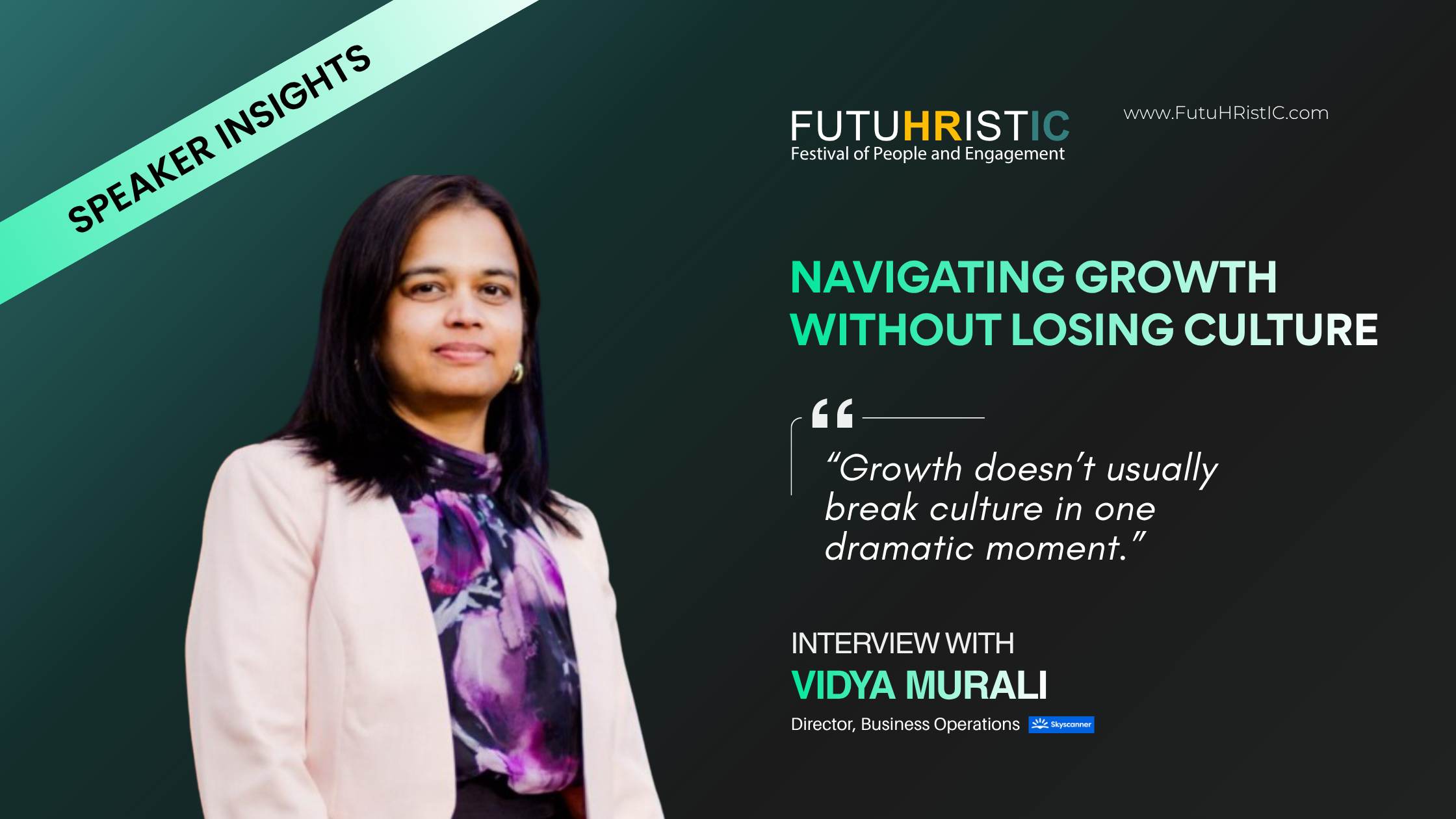
Speaker Insights: Vidya Murali, Director, Business Operations, Skyscanner
As organisations continue to scale at speed, many leaders are discovering that growth brings far more than opportunity. Alongside expansion comes increasing complexity, shifting priorities, evolving team dynamics, and growing pressure on culture, leadership, and decision-making.
At FutuHRistIC Festival 2026, The Festival of People & Engagement, leaders from HR, operations, transformation, communications, culture, and technology will come together in London to explore the realities shaping the future of work. Through keynote sessions, practical workshops, and cross-functional conversations, the festival creates space for honest discussions around leadership, growth, workplace culture, and organisational change.
In this edition of our Speaker Insights interview series, we speak with Vidya Murali, Director of Business Operations at Skyscanner, whose session at the festival will explore the realities of scaling businesses, navigating complexity, and maintaining strong culture and leadership during periods of rapid growth.
With experience spanning Deliveroo, Skyscanner, and multiple high-growth organisations, Vidya brings a practical and people-focused perspective to the challenges many modern businesses are quietly navigating behind the scenes.
We’re delighted to have you join us at the FutuHRistIC Festival 2026 this year. Your work spans business operations, strategic programmes, AI implementation, and leadership within fast-scaling organisations. What key themes and conversations will you be exploring during your session?
Thank you, I’m delighted to be part of it.
My session, ‘When Growth Breaks Your Culture (and Your People)’, explores a reality many fast-growing organisations feel but don’t always say out loud.
We spend a lot of time celebrating growth, revenue growth, customer growth, and headcount growth. But we spend less time talking about what growth puts under pressure.
Culture.
Leadership.
Decision-making.
Trust.
People’s capacity to keep going.
Growth is often seen as proof that everything is working.
But growth also has a way of exposing what isn’t.
One minute, you’re moving fast with a tight-knit team. The next decision-making feels slower, roles feel blurred, and everyone is in more meetings than they’d ever admit publicly.
My session is about helping leaders recognise those moments early and understand how to scale performance without losing culture or burning people out along the way.
Because growth doesn’t usually break culture in one dramatic moment.
It happens quietly, in the gaps between speed and clarity.
Much of your career has been spent navigating high-growth and scale-up environments, from Deliveroo to Skyscanner and multiple start-ups. What first drew you to the challenge and energy of scaling businesses?
I’ve always been drawn to change.
I’m energised by environments where things are evolving quickly, where businesses are growing, teams are adapting, and what worked six months ago already needs rethinking.
Scale-ups naturally bring that.
They’re fast-moving, ambitious, unpredictable, and full of possibility.
What keeps me interested is how growth changes not just the business, but the people inside it.
How leaders adapt.
How teams respond under pressure.
How culture evolves as the organisation scales.
That intersection of change, complexity and human behaviour is what I find most fascinating.
No two scale-up journeys look the same, and that’s exactly what makes the work so interesting.
You also speak and write about what it really takes to survive in a scale-up business. In your experience, what are some of the biggest realities or leadership challenges that people are often unprepared for when organisations grow rapidly?
One of the biggest surprises is how quickly growth creates complexity.
That’s something I explore in How to Survive in a Scale-Up Business, how the very things that make scale-ups exciting can also make them incredibly difficult to navigate once the business starts maturing.
People join for speed, ownership and impact.
And then they discover that speed often comes bundled with ambiguity.
Roles evolve before job descriptions do.
Priorities shift before teams have caught up.
And structures appear… usually a few months after everyone needed them.
One of the most interesting patterns I’ve seen is businesses hiring brilliant people from highly successful global brands, and then being surprised when they struggle.
Not because they aren’t talented.
But success in a large company doesn’t automatically translate into success in a scale-up.
In bigger organisations, you often inherit structure.
In a scale-up, you’re often creating structure while trying to deliver results inside it.
I once heard someone describe scaling as:
‘Building a parachute after you’ve already jumped.’
And that feels incredibly accurate.
Everyone’s moving fast.
The ground is getting closer.
And someone is still debating the design.
That’s why I often say:
Brand names don’t guarantee scale-up success. Adaptability does.
And: Your best hire on paper isn’t always your best hire in practice.
Your work combines strategy, operations, customer experience, and now AI-driven programmes. How important is cross-functional collaboration when it comes to successfully driving transformation and execution at scale?
It’s essential.
Scale doesn’t happen inside functions.
It happens between them.
Strategy depends on operations.
Operations depend on people.
Technology depends on adoption.
Customer experience depends on all of it working together.
The organisations that scale well aren’t always the ones with the boldest strategy.
They’re often the ones who collaborate well enough to execute consistently.
Cross-functional collaboration is where strategy becomes reality.
Without it, transformation looks great on slides, and much harder in practice.
Many organisations talk about innovation, but executing strategy effectively is often where the real challenge begins. What do you think separates businesses that successfully turn ideas into action from those that struggle to deliver?
Clarity.
Most organisations don’t struggle because they lack ideas.
If anything, they usually have too many.
What they struggle with is focus.
The businesses that execute well are clear about priorities, ownership, decision-making, and what success actually looks like.
Without that clarity, people stay busy, but progress feels slower than it should.
Meetings multiply.
Projects overlap.
Work expands.
Energy gets diluted.
And everyone is quietly wondering:
‘Are we moving forward, or just moving?’
Execution is rarely about doing more.
More often, it’s about removing friction so the right work can move.
You’ve led teams through rapid growth, ambiguity, and constant change across multiple industries. How has your leadership style evolved over the years when managing fast-moving and uncertain environments?
Earlier in my career, I thought leadership meant having answers.
Over time, I’ve realised leadership is much more about creating clarity when answers aren’t obvious.
My style today is less about control and much more about context.
Helping teams understand what’s changing.
Helping them focus on what matters.
Helping them move forward even when things feel uncertain.
In fast-moving environments, leaders can’t remove complexity.
But they can reduce confusion.
And confusion is often what drains teams fastest.
AI is becoming an increasingly important part of business operations and customer experience strategies. From your perspective, how can organisations embrace AI while still maintaining strong human leadership and decision-making?
AI will absolutely reshape the way organisations work, but leadership remains deeply human.
AI can improve efficiency, automate tasks, surface insights and accelerate decisions.
But it can’t replace judgment.
It can’t replace trust.
It can’t replace empathy.
And it definitely can’t navigate the emotional dynamics of a leadership meeting after someone says, ‘I have a slightly different view…’
The opportunity isn’t AI versus people.
It’s AI enabling people to do better work while leaders focus on the decisions only humans can make.
Technology can scale systems.
People still scale culture.
And culture remains a competitive advantage.
A recurring theme in your work is operating within “real-world complexity” rather than leadership theory alone. Why do you think practical, experienced leadership conversations resonate so strongly with today’s leaders?
Because leaders are operating in complexity every day.
They’re managing growth, change, competing priorities, pressure, uncertainty, and trying to keep teams engaged through all of it.
Theory is useful.
But lived experience is often what makes ideas actionable.
Leaders want practical conversations grounded in reality.
What happens when communication breaks down?
What happens when trust dips?
What happens when your strongest people start leaving?
What happens when growth creates more friction than momentum?
Those are the conversations leaders are having behind closed doors.
And increasingly, they’re the conversations people are ready to have openly.
One of the strengths of FutuHRistIC Festival 2026 is bringing together leaders from operations, HR, culture, transformation, communications, and technology into one space. What value do you think comes from having those cross-functional conversations together?
Huge value.
Because growth challenges rarely belong to one function.
Culture isn’t just HR.
Transformation isn’t just operations.
AI isn’t just technology.
The most important business challenges tend to sit in the overlap between teams, between priorities, and between ways of working.
Cross-functional conversations create shared context.
And shared context solves more problems than most strategy documents ever will.
That’s where better decisions happen.
For someone attending your session at the festival, what would you most like them to walk away thinking differently about when it comes to leadership, scale-up culture, and navigating growth?
I’d love people to leave with this thought:
If growth feels harder than it should, it doesn’t automatically mean your people are the problem. Often, the culture around them needs to evolve.
I want leaders to think differently about culture, not as something separate from performance, but as the infrastructure behind performance.
Because culture isn’t what’s written on a values slide.
It’s how people feel when the pressure shows up.
It’s how decisions get made.
How conflict gets handled.
How trust holds, or doesn’t.
And how people experience work as the business scales.
The most successful companies don’t just scale their business.
They scale their people, their culture, and their capacity to thrive.
About FutuHRistIC™ Festival
Since 2012, FutuHRistIC™ has been connecting people, culture, and communication. Now in its 12th year, this four-day London festival breaks down the silos between disciplines, bringing together the Reinventing HR Summit and the Internal Communications Conference. It is a collaborative space for forward-thinking people leaders and communication professionals to step away from day-to-day pressures, challenge ideas, and shape a more connected, human future of work.
With registrations now open, we invite professionals from across industries to join the conversations shaping the future of leadership, communication, culture, employee engagement, and organisational transformation.
Discover more about the festival, speakers, and programme updates at FutuHRistIC Festival.


